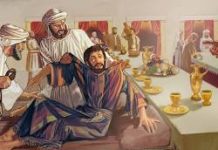
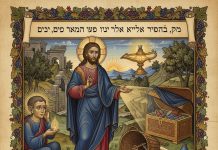
Jesus Stresses the Importance Of persistence in life Luke 11/05-08: “And he said to them, ‘Suppose one of you has a friend, and you go to him at midnight and say to him, “Friend, lend me three loaves of bread; for a friend of mine has arrived, and I have nothing to set before him.” And he answers from within, “Do not bother me; the door has already been locked, and my children are with me in bed; I cannot get up and give you anything.”I tell you, even though he will not get up and give him anything because he is his friend, at least because of his persistence he will get up and give him whatever he needs.”
In ordinary times, holding fast to principled positions may seem easy. However, in times of pressure, threats, terrorism, and occupation, standing firm for the truth becomes an act of courage and faith. This highlights the necessity for every individual, and the people as a whole, to remain anchored to their national and humanitarian convictions, no matter how difficult the circumstances or how great the dangers. True faith is not limited to prayer and worship; it is embodied in the rejection of injustice and subjugation, and in the defense of freedom, sovereignty, and human dignity.
In the Lebanese context, rejecting terrorism and all forms of guardianship, occupation, or foreign hegemony—foremost among them being Iranian hegemony over Lebanese decision-making—should not be a situational stance dictated by the balance of power. Rather, it must be a firm, principled position rooted in the belief in justice and the right of peoples to determine their own destiny freely. A person with a just cause does not retreat because the road is difficult, does not remain silent because the price is high, and does not compromise because the pressures are immense. Instead, they continue to carry their national message, advocate for it, and defend it, because the truth is not measured by the number of its supporters nor by the magnitude of the force opposing it.
Experience has taught us that falsehood may swell and exert power for a time, but it can never transform into truth. Power may impose a temporary reality, but it cannot bestow legitimacy upon what is illegitimate. This is why free peoples have struggled, generation after generation, in defense of their homelands, believing that “the truth rises above and cannot be surpassed,” and that “no right dies so long as there is someone demanding it.” The victory of truth may be delayed, but it is never defeated. Its advocates may face persecution, character assassination, or isolation, but the truth remains alive in the conscience until it is realized.
From this perspective, steadfastness in the truth becomes a moral, spiritual, and national virtue all at once. True persistence is not “blameworthy obstinacy,” such as insisting on an error; rather, it is a “sacred persistence” that expresses firm faith, deep conviction, and a readiness to bear the consequences of defending one’s principles. Not every act of holding fast is mere stubbornness or pride; it is loyalty to the truth. It requires moral courage that makes one ready for confrontation when confident in the justice of their cause. History has not progressed thanks to the hesitant or those who surrender their principles, but thanks to the men and women who believed in the truth and held onto it to the very end.
The Holy Bible has repeatedly emphasized the importance of perseverance—not only in seeking material things, but in faith, prayer, and the defense of truth. The Lord Jesus taught His disciples that a believer should not surrender at the first obstacle, but should persist and knock until the door is opened. In the Gospel of Luke, the Lord says: “Which of you who has a friend will go to him at midnight… I tell you, though he will not get up and give him anything because he is his friend, yet because of his impudence [persistence] he will rise and give him whatever he needs.” (Luke 11:5-8). In this parable, Jesus praises “sacred persistence.” The friend received what he asked for not only because of their relationship, but because of his insistence and refusal to give up. This teaches us that steadfastness in asking is a sign of faith, not a sign of weakness.
The Gospel provides vivid examples of this perseverance:
The Canaanite Woman: Who did not retreat despite the apparent silence, continuing to plead until she earned Christ’s admiration for her faith: “O woman, great is your faith! Let it be to you as you desire.”
The Blind Man on the Roadside: Who did not allow the rebukes of the crowd to extinguish his hope, but cried out all the more until he stopped Jesus and regained his sight.
The Persistent Widow: To whom the judge responded because of her perseverance, leading Christ to emphasize that believers “ought always to pray and not lose heart.”
The actions urged by Christ: “Ask, and it will be given to you; seek, and you will find; knock, and it will be opened to you” (Luke 11:9-10), are expressed in a tense that implies continuity and persistence. It is a clear teaching that a believer does not stop at the first obstacle but continues to strive toward the truth until the goal is achieved.
The supreme example remains in the person of Jesus Christ Himself. When He stood before Pilate and the religious and political authorities who sought to condemn Him, He did not retreat from His mission nor compromise the truth He came to testify to. He stood firm in declaring that His kingdom is not of this world, and He accepted the suffering and the Cross without denying the truth He bore.
The world today needs people of principle, whose positions do not shift with changing interests and whose convictions do not change under the pressure of fear or temptation. Steadfastness in the truth is not fanaticism; it is moral and spiritual commitment. When this steadfastness is built upon faith in God and trust in His promises, it transforms into a power capable of changing reality and shaping history. The believer is called to hold fast to the truth, for truth does not triumph except through those with steadfast hearts who understand that sacred persistence in the path of truth is the way to blessing and victory.