
Saint Charbel Makhlouf: An Expanded Biography of the Life and Holiness of Lebanon’s Great Hermit
Elias Bejjani/July 23/ 2026
Note: The information presented in this study has been compiled from numerous reputable ecclesiastical, theological, historical, and scholarly sources.
Click Here to read the Arabic version of this piece/اضغط هنا لقراء المقالة بالعربية
Introduction
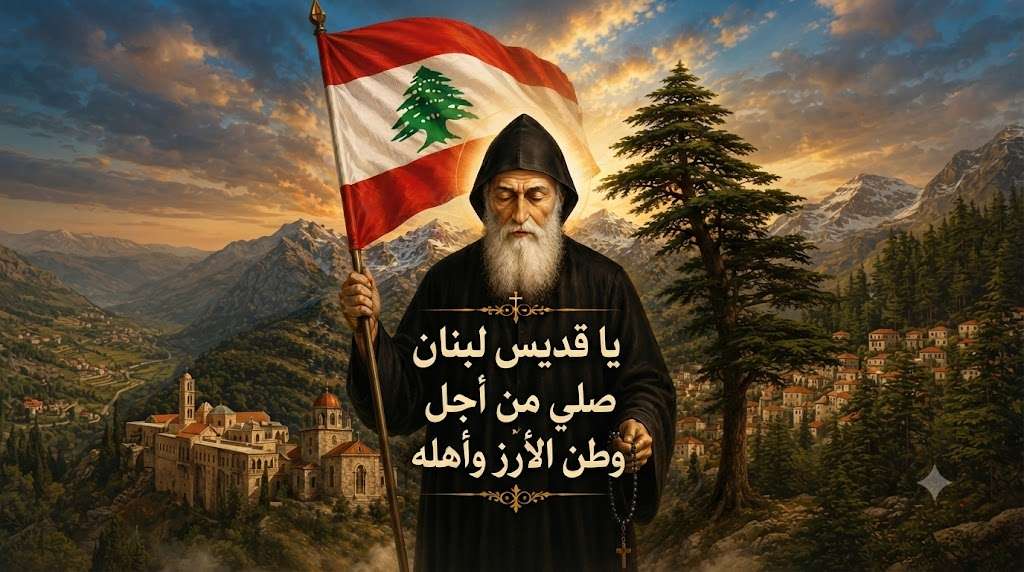
Saint Charbel Makhlouf is one of the most renowned saints of the Maronite Church and the Catholic Church in modern times. His fame has spread far beyond Lebanon and the Middle East to every continent of the world. Millions of believers know him as the “Heavenly Physician” because of the countless graces, healings, and miracles attributed to his intercession. Maronites and Catholics celebrate the feast of Saint Charbel each year on July 23, commemorating his passing from this earthly life into eternal glory. His life remains a remarkable example of asceticism, prayer, self-denial, and obedience. He has become a spiritual symbol of Lebanon and of the Universal Church, while his shrine in Annaya is today one of the most important Christian pilgrimage sites in the world.
His Birth Name and Early Life
Saint Charbel was born Youssef Antoun Makhlouf on May 8, 1828, in the village of Bekaakafra in the district of Bsharri in northern Lebanon. Bekaakafra is considered one of the highest inhabited villages in Lebanon.
His father was Antoun Makhlouf, and his mother was Brigitte Chidiac. Youssef grew up in a humble and devout rural family whose livelihood depended on farming and livestock raising. He lost his father at a young age, a hardship that marked his childhood. From an early age, he showed signs of deep piety and a strong attraction to prayer and solitude. He often withdrew to a nearby cave to pray in silence, and the villagers sometimes referred to him as “the little hermit.”
His Religious Calling and Entrance into Monastic Life
From his youth, Youssef felt a powerful call to the monastic life. In 1851, he secretly left his family home and entered Our Lady of Mayfouq Monastery, belonging to the Lebanese Maronite Order.
Upon entering religious life, he took the name Charbel, in honor of Saint Charbel of Antioch, a Christian martyr of the second century. After a period of formation, he moved to Saint Maroun Monastery in Annaya, where he continued his monastic journey. On November 01,1853, he professed his first monastic vows.
He later pursued his philosophical and theological studies at Kfifan Monastery, where he studied under the guidance of the holy monk Nimatullah Al-Hardini, who would later be canonized as a saint of the Maronite Church.
His Priestly Ordination
Father Charbel was ordained a priest on July 23, 1859. Remarkably, this same date would later become his liturgical feast day. Following his ordination, he returned to Saint Maron Monastery in Annaya, where he devoted himself to a life of prayer, labor, and silence.
His Life at Annaya Monastery
Saint Maron Monastery in Annaya, located in the Jbeil region of Lebanon, has become one of the most famous monasteries in the Christian world because of its association with Saint Charbel.
He lived there for more than sixteen years as a monk before moving to the hermitage.
He became known for:
Long periods of silence.
Complete obedience to his superiors.
Profound humility.
Love for the poor.
Constant devotion to the Holy Eucharist.
Severe asceticism.
He firmly believed that monks should live the Gospel in practice and not merely in theory.
His Move to the Hermitage
A hermitage is a place of strict monastic solitude where a hermit lives a life of prayer, contemplation, and work apart from the world. In 1875, his superiors granted him permission to move to the Hermitage of Saints Peter and Paul, located near Annaya Monastery. There he spent the final twenty-three years of his life.
A Life of Asceticism and Prayer
Saint Charbel’s life in the hermitage is considered one of the most rigorous examples of asceticism in Maronite monastic history.
His daily life centered on:
Prayer/He spent long hours in prayer before the Blessed Sacrament.
Fasting/He fasted during most days of the year.
Vigil/He slept only a few hours each night.
Manual Labor/He participated in simple agricultural work.
Silence/He spoke only when absolutely necessary.
His Personal Virtues
Humility/He never sought position, recognition, or fame. He considered himself the least among the monks.
Obedience/He faithfully carried out the instructions of his superiors without complaint.
Voluntary Poverty/He embraced poverty throughout his entire life.
Constant Prayer/Those who knew him regarded him as a man who lived continually in the presence of God.
Love for the Eucharist/ The Holy Sacrifice of the Mass was the center of his spiritual life.
His Death
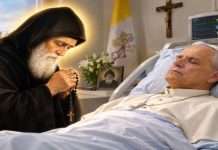
On the evening of December 16, 1898, while celebrating the Divine Liturgy in the hermitage, Father Charbel suffered a stroke. He remained ill for several days before passing away on December 24, 1898. The Maronite Church celebrates his liturgical feast on July 23, the date associated with his priestly ordination and spiritual remembrance within the Church tradition. He was seventy years old at the time of his death.
Events Following His Death
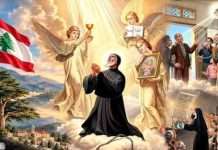
Soon after his burial, extraordinary events began to occur. Residents of the area reported seeing mysterious lights emanating from his tomb during the night. Because these occurrences continued, Church authorities opened the tomb several months later. To their astonishment, his body was found largely incorrupt and preserved in an unusual manner. It was also observed to exude a fluid resembling a mixture of water and blood. This phenomenon continued for many years. His remains were examined on several occasions during the twentieth century, attracting the attention of physicians, researchers, clergy, and pilgrims from around the world. Today, the saint’s relics are preserved at his shrine in Annaya, which receives millions of pilgrims.
Annaya Monastery and His Shrine
Saint Maron Monastery in Annaya has become the worldwide center of devotion to Saint Charbel.
The site includes:
The saint’s tomb.
A museum containing his personal belongings.
The historic monastery church.
The modern basilica.
A pilgrims’ reception center.
Every year, visitors arrive from Lebanon, the Arab world, Europe, the Americas, Africa, and Asia.
His Beatification
After extensive study of his life and miracles, the Cause for Beatification was introduced in Rome.
On December 5, 1965, Pope Paul VI declared Father Charbel Blessed during the Second Vatican Council. This event marked a historic milestone for the Maronite Church.
Twelfth: His Canonization
Following the recognition of additional miracles in Lebanon and many other countries, his cause was further examined.
On October 9, 1977, Pope Paul VI canonized him as a saint of the Universal Church.
Since that day, he has been officially venerated throughout the Catholic world as Saint Charbel Makhlouf.
Thirteenth: Some of the Most Famous Miracles Attributed to His Intercession
Thousands of spiritual and medical testimonies have been attributed to Saint Charbel’s intercession.
Among the most notable are:
The Healing of Sister Marie Abel Kassis/This miracle played a central role in the process leading to his beatification. She was cured of severe illnesses after invoking his intercession.
The Healing of Nohad El Shami/ Her case became one of the most famous modern miracles associated with Saint Charbel. She was reportedly healed from a serious paralysis, and two unusual wounds appeared on her neck following a vision of the saint.
Healings from Cancer/
Numerous testimonies from Lebanon and abroad describe recoveries from various forms of cancer attributed to his intercession.
Healings from Blindness and Paralysis/
Church and medical commissions have documented many reports concerning the healing of severe and incurable conditions.
The administration of the Annaya shrine continues to receive reports and testimonies from countries throughout the world.
Fourteenth: The Spread of His Veneration Throughout the World
Today, Saint Charbel is among the most widely venerated saints of the Christian East.
Churches, monasteries, shrines, and chapels dedicated to him can be found in dozens of countries, including: Lebanon, Syria, Egypt, Jordan, Iraq, Israel, the United States, Canada, Mexico, Brazil, Argentina, Chile, Australia, France, Italy, Germany, Belgium, South Africa, and the Philippines.
Hundreds of churches, chapels, and shrines bearing his name have been established across the globe.
Fifteenth: The Spiritual Importance of Saint Charbel
The significance of Saint Charbel lies in the fact that he:
United prayer and work.
Lived the Gospel with extraordinary fidelity.
Embodied the spirituality of Eastern Christianity.
Offered a universal model of asceticism and contemplation.
Became a spiritual bridge between East and West.
For this reason, Christians, Muslims, and people of various religious backgrounds visit his shrine seeking prayer, healing, and blessings.
A Prayer Through the Intercession of Saint Charbel for Lebanon
Lord God, Master of history and of all nations, we ask You through the intercession of Saint Charbel Makhlouf, Hermit of Annaya and Saint of Lebanon and the world, to look with mercy upon Lebanon and its people. Grant its sons and daughters wisdom, courage, and fidelity to the truth. Bless every effort that seeks justice, peace, freedom, and human dignity. Protect Lebanon from violence, division, and corruption. Strengthen the rule of law and its institutions, and safeguard its sovereignty, independence, and territorial unity. Lord, heal the wounds of the Lebanese people, comfort those who suffer, and grant all public servants the grace to work faithfully for the common good.
Through the intercession of Saint Charbel, make Lebanon once again a land of encounter, love, witness, and mission, according to Your holy will.To You be glory forever and ever.
Amen.
Conclusion
Saint Charbel remains one of the most prominent spiritual figures in the history of Eastern Christianity. His hidden life in a small hermitage in Annaya became a universal testimony to faith, prayer, holiness, and total dedication to God. Today, his name is honored in hundreds of churches, monasteries, and shrines throughout the five continents, making him one of the most beloved saints of the modern era.
The author, Elias Bejjani, is a Lebanese expatriate activist
Author’s Email: Phoenicia@hotmail.com
Author’s Website: https://eliasbejjaninews.com
Elias Bejjani
Canadian-Lebanese Human Rights activist, journalist and political commentator
Email phoenicia@hotmail.com & media.lccc@gmail.com
Web Sites https://eliasbejjaninews.com & http://www.10452lccc.com & http://www.clhrf.com
Twitter https://x.com/bejjani62461
Face Book https://www.facebook.com/groups/128479277182033
Face Book https://www.facebook.com/elie.y.bejjani/
Instagram https://www.instagram.com/eliasyoussefbejjani/
Linkedin https://www.linkedin.com/in/elias-bejjani-7b737713b/
Youtube https://www.youtube.com/channel/UCAOOSioLh1GE3C1hp63Camw