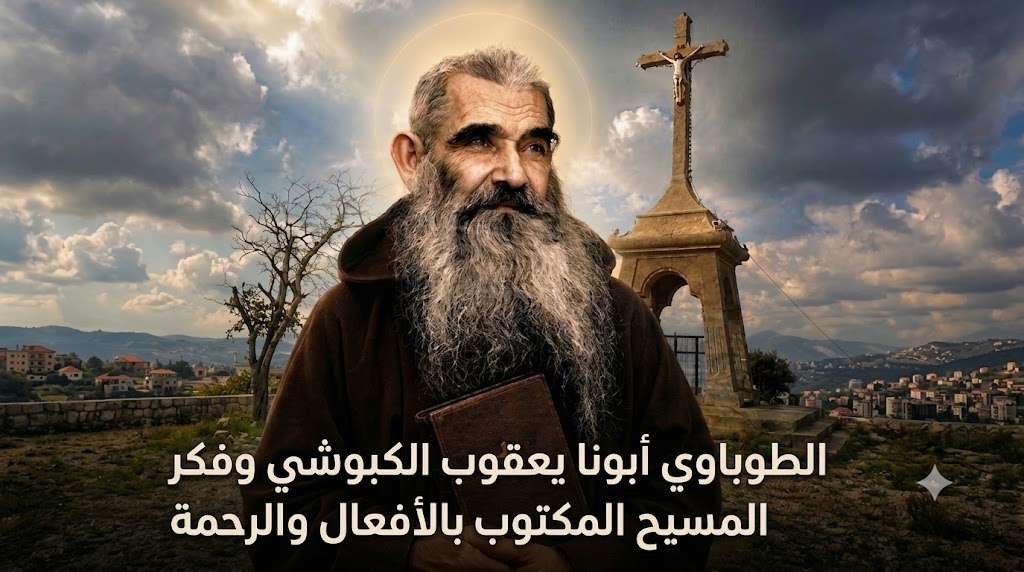
In Memory of Blessed Father Yaacoub the Capuchin, The Mind of Christ Written in Deeds and Mercy
Elias Bejjani/June 26/ 2026
In the spiritual depths of Christianity, faith does not stop at the boundaries of theoretical contemplation or passing emotional sentiments. Rather, it is a permanent movement of love—constantly ascending toward God and constantly bending down toward humanity. Saint James formulated this essential truth with a decisive, definitive phrase in his epistle when he said: “Faith by itself, if it is not accompanied by action, is dead” (James 2:17).
This living faith, which does not settle for saying “Lord, Lord,” is the very divine spark that ignited the heart of Blessed Father Yaacoub the Capuchin. Khalil Haddad (Father Yaacoub) was not a monk who locked the Gospel between the covers of a book; rather, he embodied it as a “living Gospel” walking upon the earth. He realized that words without actions are an empty echo, so he translated his watchful prayers into writing—penned with the sweat of his brow and the tears of service—upon the bodies of the sick, the tears of the hungry, the elderly priests, and the abandoned.
The faith-driven motivation for Father Yaacoub sprang from seeing the face of Christ mysteriously present in every broken human being. He did not view a psychiatric patient at “The Convent of the Cross” or an elderly priest at “Christ the King” as a social burden. Instead, he saw Christ Himself in them, who said: “Whatever you did for one of the least of these brothers and sisters of mine, you did for me” (Matthew 25:40). Therefore, his faith transformed into a silent, mighty “revolution of love,” mirroring the commandment of John the Apostle: “Let us not love with words or speech but with actions and in truth” (1 John 3:18).
Identity and Roots: Who is Khalil Haddad?
Blessed Father Yaacoub the Capuchin (Khalil Haddad) whose feast the Church celebrates today was born in the historic Keserwan town of Ghazir, Lebanon, on February 01, 1875. His real name before donning the monastic habit was Khalil Haddad. Khalil grew up in a pious family that taught him the love of God and self-sacrificing service. He received his early education in the town’s school, then moved to La Sagesse (Al-Hikma) School in Beirut, where he stood out for his sharp intelligence and linguistic eloquence. In the midst of his successes, he felt a powerful monastic calling pressing upon his heart. He did not hesitate; he chose the path of poverty, humility, and hard labor with the Order of Friars Minor Capuchin.
The Secret of the Altar: When and how was he ordained a priest?
After completing his deep monastic and theological studies and professing his solemn vows, Khalil Haddad was ordained a priest on November 01, 1901, in the Church of Saint Anthony of Padua of the Capuchin Fathers in Beirut. On that sacred day, he took the name “Father Yaacoub” (known popularly as “Abouna Yaacoub”). From the moment he wore the priestly vestments, he launched into a continuous workshop of spiritual and social labor whose flame never dimmed throughout the long decades of his life.
A Revolution of Love: What are his most prominent achievements?
Father Yaacoub was not a monk content with contemplative prayers within the walls of a cell; he was a man of the field who ran after human pain wherever it was found. The medical and educational institutions he scattered across the hills of Lebanon were not merely administrative achievements, but a practical rendering of his deep-rooted faith. Among his most prominent achievements were:
*Establishing the Congregation of the Franciscan Sisters of the Cross (1930): Which became the executive and spiritual arm managing his massive institutions and caring for the abandoned.
*Launching a Comprehensive Educational Renaissance: By establishing free schools in remote villages and towns to empower children of the poor classes to receive an education.
*Establishing the “Library of Love”: As a tool to spread culture, awareness, and spiritual and moral literacy.
*Building the Monument of “Our Lady of the Mountain” and the “Shrine of the Cross of Lebanon”: In the Jal El Dib region, to serve as a unifying spiritual beacon gathering the Lebanese people around the Cross.
Citadels of Humanity: The institutions he built and helped launch
He believed that every stone he raised to shelter an orphan or an elderly person was a physical prayer ascending to heaven. By virtue of this faith, Father Yaacoub became a complete “social and health safety net” embodied in a single man. Here are the humanitarian citadels he constructed:
*The Convent of the Cross Hospital (Jal El Dib): The most prominent and largest institution, dedicated to receiving psychiatric and mental health patients, as well as those abandoned on the streets whom society had cast away and who had no breadwinner.
*Our Lady of the Sea Hospital (Byblos/Jbeil): A distinguished health center fully dedicated to the care of chronic patients and the elderly.
*Saint Joseph Hospital and School (Dora): To serve working-class and poor families in the suburbs of Beirut, securing free medical care and education for their children.
*Christ the King Convent (Zouk Mosbeh): A unique, exceptional institution dedicated exclusively to housing elderly and sick priests and monks, honoring their old age and long service to the parish.
*Our Lady of Hope Hospital (Baalbek): To extend the bridges of care and medical services to the beloved Beqaa region.
*The Home for the Elderly (Al-Mina, Tripoli): To serve the elderly and the homeless abandoned in northern Lebanon.
*Free Schools: He founded more than 15 free schools in various Lebanese regions to support the families most in need.
The Embracing Father: The humanitarian role of Yaacoub the Capuchin
Father Yaacoub’s role as a true social safety valve manifested during difficult periods that Lebanon endured, particularly following the aftermath of World War I and the Great Famine. He never discriminated based on sect, denomination, or religion. He used to roam the country gathering donations with the boldness of a defender of truth and the humility of a monk, until he was nicknamed in popular circles as the “Beggar of Charity.” Through his life, he proved that a priest is not just someone who preaches from a pulpit, but someone who washes the wounds of humanity with the shroud of mercy, walking in the footsteps of his Master who “went about doing good” (Acts 10:38). He focused his utmost attention on the groups from which society turned away in shame or marginalized, restoring human dignity to their hearts.
The Crossing to Heaven: A legacy renewed every year
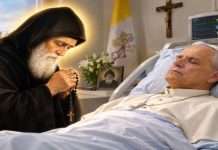
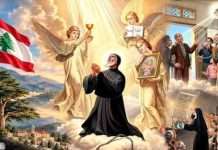
After a journey filled with total self-giving and supreme benevolence, Father Yaacoub the Capuchin slept in the odor of sanctity on June 26, 1954, at the age of 79. Given his pure life overflowing with miracles and signs of grace, Pope Benedict XVI declared him Blessed upon the altars of the Universal Catholic Church in a historic and solemn celebration witnessed at Martyrs’ Square in Beirut on June 22, 2008. The Church designated June 26 as his annual feast day, which is the day of his crossing into the heavenly chambers.
Father Yaacoub the Capuchin remains the greatest witness in our modern history that deeds are the soul and pulse of faith, and that true faith is the one that speaks the language of tireless giving.
The Prayer of Father Yaacoub from His Heavenly Abode for Suffering Lebanon
From the heights of your heaven, O Father of the Poor and Apostle of Mercy, where you stand today alongside the righteous and the saints in the presence of the Lord of Glory, look down with a tender, fatherly gaze upon your homeland, which lies beneath the Golgotha of pain. Lebanon—whose hills you stamped with the kisses of prayer and above whose peaks you raised the Cross of Redemption—groans today under the weight of suffering, its dignity gnawed at by forces of occupation, injustice, and displacement.
O Beggar of Charity, we implore you today to be our fervent intercessor before the Divine Throne:
Intercede for the suffering and the displaced: O you who sheltered the abandoned without a home, wipe away the tears of families that have been displaced, protect the children whose innocence has been stolen, and be a support for every soul broken by hunger and oppression.
Liberate this occupied nation: O you who fought with your free faith against injustice and reliance on mortals, pray so that Lebanon may shake off from its shoulders the dust of dependency and occupation, and that its plundered sovereignty and dignity may return to it, so that it remains a nation of freedom and a message.
Cultivate within us the spirit of solidarity and action: Just as you transformed your faith into citadels of mercy and institutions, pray so that faith does not die in our hearts, but rather embodies itself in deeds of love and steadfastness, so that we may support one of another in these difficult days.
O our Father Yaacoub, you who closed your eyes upon the land of Lebanon while commanding love, do not leave the Land of the Cedars to fall into the abyss of oblivion. Be a safety valve for us from your heavenly abode, and pray to Christ the King to dispel the darkness of this long night, so that Lebanon may rise from the tomb of its suffering victorious, with a glorious resurrection that bears witness to the power of life and truth.
Amen.
NB: The information in this study is cited from various documented ecclesiastical, theological, research, and media references.