The Anniversary of the Canonization of Saint Charbel – Which Took Place on 9 October 1977 / Who is this Saint and What is His Biography
Elias Bejjani/09 October/2026
The Saint of Lebanon Who Made the Silence of the Hermitage a Pulpit for the World
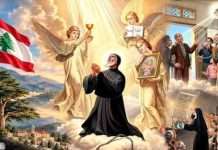
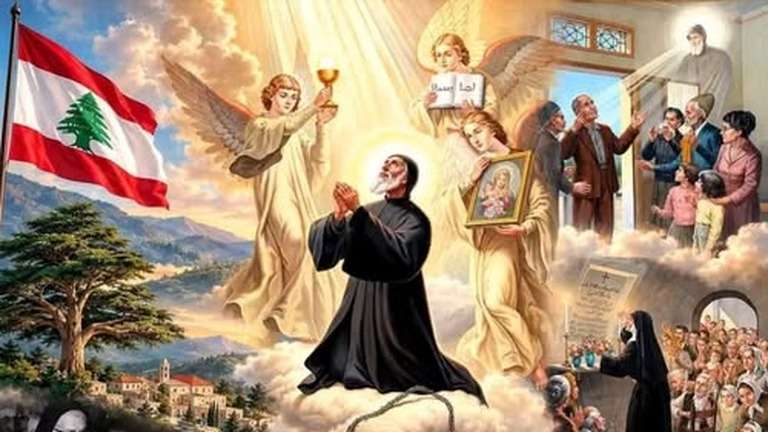
On the 9th of October 1977, Pope Saint Paul VI raised to the altars of the Universal Church a son of Lebanon, a humble hermit from Bekaa Kafra, to be a saint for the whole world. The canonization of Charbel was not merely a Vatican event; it was a heavenly proclamation that holiness is still possible in our time, and that Lebanon, the land of saints, offers to the Church a living model of prayer, silence and labor.
Biography – From Bekaa Kafra to Heaven
Birth and Early Life
Youssef Antoun Makhlouf was born on 8 May 1828 in the village of Bekaa Kafra, the highest inhabited village in Lebanon (in the district of Bcharre, on the slopes of the Cedars). He was born into a poor yet pious farming family. His father, Antoun Zaarour Makhlouf, died when Youssef was only three years old, and he was raised by his mother Brigitta. From his childhood he was called “the Saint” because of his love for prayer and solitude in a grotto near the village which he called “the Grotto of the Saints.”
The Monastic Vocation
On a morning in the year 1851, at the age of 23, he left Bekaa Kafra without bidding farewell to anyone, walking on foot to the Monastery of Our Lady of Mayfouq to seek entry into the Lebanese Maronite Order. He was later transferred to the Monastery of Saint Maron – Annaya for his novitiate.
Date of entry into monastic life: 1851 at Mayfouq
Transfer to Annaya: 1853
First monastic vows: 1 November 1853, taking the name Charbel, after the second-century Antiochene Martyr, Saint Charbel
Theological Studies: At the Monastery of Saints Cyprian and Justina – Kfifan, where he was discipled by Saint Nimatullah Kassab Al-Hardini, who was his professor and spiritual director
Priestly Ordination: He was ordained a priest on 23 July 1859 in Bkerke by the laying on of hands of Bishop Youssef Al-Mourad (El-Marid), the Patriarchal Vicar, during the pontificate of Patriarch Paul Peter Massaad.
He spent 16 years as an exemplary monk in the Monastery of Annaya, a model of obedience, humility and manual labor in the fields.
The Eremitic Life
His greatest longing was to revive the life of the ancient hermits. After long insistence, he was permitted to withdraw to the Hermitage of Saints Peter and Paul, belonging to the Monastery of Annaya, overlooking the Holy Valley.
Date of entry into the hermitage: 13 February 1875
Place: The Hermitage of Saints Peter and Paul – Annaya
Date of Death: 24 December 1898
There he spent 23 years, never leaving except by order of his superior, praying, fasting, keeping silence, working in the field, and spending the night kneeling before the Blessed Sacrament.
He died on Christmas Eve, 24 December 1898, while reciting the Christmas Mass. His last words were: “O Father of Truth.” He was buried in the monastery cemetery at the age of 70.
His Most Notable Miracles
The miracles began at the moment of his death. Eyewitnesses saw a dazzling light emanating from his grave for several months, and his body continued to exude blood, water and sweat after his death, remaining intact and supple for many years without any embalming.
The Church cannot number the miracles, but we mention those adopted in the cause for canonization:
A- During his lifetime
The Miracle of the Lamp: Once the servant asked him to fill the lamp with oil, and out of holy obedience he filled it with water, and the lamp burned with water.
He healed the sick and wounded by his prayers and the blessing of his hand, and cast out evil spirits.
B- After his death – The miracles that opened the door to beatification and canonization:
The healing of Sister Mary Abel Kamou of the Sisters of the Sacred Hearts: She had suffered from severe, incurable intestinal ulcers for 14 years. She visited his grave and prayed, and was suddenly and completely cured in 1950. This is the miracle adopted for his beatification.
The healing of Mr. Alexandre Obeid from Baabdat: He had lost sight in one eye as a result of an accident. After praying to Saint Charbel and placing soil from his grave upon his eye, he fully regained his sight in 1950. This is the second miracle for beatification.
The healing of Mrs. Mariam Awad from Hammana: She was paralyzed and suffering from cancer of the larynx. She was miraculously healed in 1952. This is the miracle adopted for his canonization.
Thousands of miracles are documented today in the records of the Monastery of Annaya from all over the world, from healings of cancer, paralysis and blindness to countless other wonders. The faithful have called him “the Doctor of Heaven” and “the Wonder-Worker.”
Beatification – Date and Place
Because of the abundance of graces and miracles, the cause for his beatification was opened in 1925.
Date of Beatification: 5 December 1965
Place: The Basilica of Saint Peter in the Vatican
Pope of Beatification: Pope Saint Paul VI
Occasion: He concluded the Second Vatican Council with it. In his homily, Pope Paul VI said: “A hermit from the mountain of Lebanon may teach us, in a materialistic world, what poverty and humility mean… a Maronite monk may teach us what silence and prayer mean.” This was the first beatification of a Maronite in modern history.
Canonization – Full Details
Date of Canonization: Sunday, 9 October 1977
Place: Saint Peter’s Square – Vatican
Pope of Canonization: Pope Saint Paul VI, and this was the last saint he canonized months before his death
Attendance: More than 30,000 Lebanese pilgrims came from Lebanon and the diaspora, led by Maronite Patriarch Antonios Khreich and a delegation of the Lebanese Maronite Order. Saint Peter’s Square resounded with Maronite and Lebanese hymns.
Decree of Canonization: The Pope proclaimed Charbel a saint of the Universal Church, and established his official feast on 24 July each year (in Lebanon it is celebrated on the third Sunday of July according to the Maronite calendar).
The Historic Homily: Paul VI said: “Charbel Makhlouf is the saint of difficult times. He made the hermitage a school of prayer. He calls you, O Christians of Lebanon and the East, to be faithful to your faith, and martyrs of love in a divided world.”
Immediately after the canonization, his relics spread to all continents, and the shrine of Annaya became the second most important Christian pilgrimage site in the Middle East after Jerusalem.
Conclusion – What Does Saint Charbel Say to Us Today?
1-The Holiness of Silence: In an age of noise and social media, Charbel teaches us that silence is not emptiness, but fullness with God. Lebanon today needs not only political solutions, but a return to the silence of the heart.
2. The Holiness of Belonging: Charbel never left Lebanon; he did not seek glory in Rome or Paris. His holiness sprouted from the soil of Bekaa Kafra and the rock of Annaya. He tells every Lebanese in the diaspora that your holiness begins where you are, but your roots remain in the land of the cedars.
3. The Holiness of Unity: Charbel is Maronite, but he became a saint for all Lebanese: Christians and Muslims, beloved by all faiths. His body has gathered Lebanese around him more than politics ever has. He is proof that holiness unites and politics divides. Saint Charbel is heaven’s answer to Lebanon’s despair. If a simple peasant from the poorest village could become a light for the world, then Lebanon is capable of rising again.
A Prayer for the Intercession of Saint Charbel for Peace in Lebanon
O Wonder-Worker Saint Charbel, O son of Bekaa Kafra and hermit of Annaya, O you who carried Lebanon in your heart and prayed for it for 23 years in your hermitage, we beseech you today while our Lebanon is wounded, divided, suffering, groaning under the weight of wars, divisions and emigration.
You who poured oil as light, pour upon our land the oil of peace. You who healed the blind, open the eyes of our leaders to see the pain of the people. You who kept long silence to hear the voice of God, teach us to be silent from hatred and insult, that we may hear the voice of our brother.
O Saint Charbel, intercede for us before the Lord Jesus, whom you loved unto death, that He may grant Lebanon a peace that cannot be bought with weapons, a unity not built upon interests, and a hope that never dies despite all hardships. Protect our cedars, protect our families in the homeland and in the diaspora, and bring the children of Lebanon back to love one another, so that Lebanon may remain as God willed it: a message of peace and light for the East and for the world. Amen.
May the intercession of Saint Charbel be with us and with Lebanon.
Note: The information contained in this study is compiled from numerous authenticated ecclesiastical, theological, research and media sources.