Elias Bejjani/Death: The Mystery of Human Existence, the Resurrection, and Eternal Life…From the Beliefs of the Phoenicians and Ancient Egyptians to the Resurrection of Jesus Christ and the Promise of Everlasting Life
Elias Bejjani/November 16/2026
Introduction: Death, the Mysterious Question That Has Haunted Humanity Since Creation
Ever since human beings first appeared on this earth, death has remained the greatest mystery confronting the human mind. It has stirred fear, occupied our thoughts, and driven us to search for answers about our destiny when the soul departs from the body, the heart stops beating, and the body returns to the dust from which it was taken. What happens to a person when he or she dies? Does existence come to an end? Does life simply vanish forever? Is there another world to which the human being passes? Will the dead ever return to life? And if physical death marks the end of earthly life, why has humanity, since the earliest civilizations, continued to hold on to the idea of immortality and the return to life? These questions are not products of our modern age. They have accompanied humanity since the dawn of history. Ancient civilizations, each according to its own culture, religious beliefs, and philosophical outlook, attempted to find answers and to understand death as a passage into another world rather than the complete disappearance of the human being. In Christian faith, however, the mystery of death cannot be fully understood apart from the mystery of the Incarnation, the crucifixion and death of Jesus Christ, and His Resurrection. Christ did not come merely to teach humanity how to live. He came to reconcile us with God, free us from the bondage of sin, and open the way to eternal life. That is why the Lord Jesus declared in unmistakable words: “I am the resurrection and the life. He who believes in Me, though he may die, he shall live.” (John 11:25). These words are not merely comforting words spoken at funerals. They are a divine declaration of the truth at the heart of Christian faith: life has triumphed over death.
First: Death in the Memory of Ancient Civilizations: The Phoenicians, the Pharaohs, and the Search for Immortality
For ancient civilizations, death was never merely a biological ending. Peoples who lived thousands of years ago regarded it as a decisive event requiring religious and ritual preparation, based on their belief that human destiny extended beyond earthly existence.
1. The Ancient Egyptians: The Pyramids and the Search for Life After Death
Ancient Egyptian civilization was among the most prominent civilizations to make life after death a central element of its religious beliefs. The ancient Egyptians believed in an existence beyond physical death. Their beliefs were closely associated with the myth of Osiris, who, according to ancient Egyptian religious tradition, was murdered and whose body was later gathered together by Isis. He was restored to life and became a symbol of death, rebirth, immortality, and the ruler of the realm of the dead. Consequently, the idea of returning to life became central to Egyptian funerary practices. The ancient Egyptians believed that preserving the body from decay helped the deceased continue to exist in the next world. They therefore developed the art of mummification, prepared tombs, and placed food, tools, jewelry, and personal possessions inside them, believing that the deceased might need these things on the journey into the afterlife.
The pyramids, among the greatest architectural achievements in human history, were closely associated with royal tombs and beliefs concerning the king’s destiny after death and his passage into the divine realm. They were not merely enormous stone structures, but part of a complex religious and funerary system reflecting the ancient Egyptians’ belief that life could continue after physical death. They also held a belief in judgment after death. The heart of the deceased was weighed against the feather of Ma’at, the symbol of truth, justice, and cosmic order. The person’s destiny depended on the outcome of this judgment. It is important, however, to distinguish these beliefs from the Christian doctrine of resurrection. The ancient Egyptians spoke of the resurrection of Osiris and the continued existence of the deceased according to their own religious rituals and concepts. Christian resurrection, by contrast, rests upon the actual Resurrection of Jesus Christ and God’s promise that the dead will rise to everlasting life.
2. The Phoenicians: Death as a Passage into Another World
The Phoenicians, the historical ancestors of the Lebanese people, were also concerned with humanity’s destiny after death. Their burial grounds, tombs, archaeological discoveries, and funerary inscriptions reveal the existence of beliefs and rituals associated with the afterlife. Their funerary practices included both burial and cremation, depending on the period, region, and local traditions. Archaeologists have also discovered personal belongings, tools, vessels, and other objects placed alongside the dead, reflecting concern for the fate of the deceased after death. Archaeological studies indicate that the Phoenicians held beliefs concerning the continued existence of the soul after death and entertained ideas about the deceased passing into another world while maintaining a connection with their families and ancestors. Their funerary practices also appear to have been intended to ensure that the deceased made the proper passage into the realm of the ancestors. It is important to acknowledge, however, that the available evidence concerning Phoenician beliefs is incomplete. We must not equate their concepts of the afterlife with the Christian doctrine of resurrection, nor claim that they held the same beliefs that Christians profess today.
The Myth of Adonis and Astarte: Death and Return in Phoenician Belief
One of the most prominent ancient myths associated with Phoenician beliefs about death and the return to life is the story of Adonis and Astarte, which held a special place in Byblos and the surrounding regions of Mount Lebanon. The name “Adonis” derives from the Semitic word “Adon,” meaning “Lord” or “Master.” Astarte was known as a goddess associated with love, fertility, and beauty. The Greeks later identified her with their goddess Aphrodite. According to one of the best-known versions of the myth, Adonis was an exceptionally handsome young man who was loved deeply by Astarte. One day, while hunting in the mountains of Lebanon, he was attacked by a wild boar and fatally wounded. When Astarte learned of his death, she was overcome with grief. Women in Byblos and other areas mourned him through ceremonies of lamentation, weeping, wailing, and ritual expressions of sorrow over the loss of the young god. The myth was also associated with the Adonis River, known today as the Ibrahim River. Ancient traditions connected the seasonal reddening of its waters with the blood of Adonis, which was said to have flowed when he was killed. This was a mythological explanation, not a scientific account of the natural phenomenon. In some versions of the myth and in certain rituals associated with his worship, mourning was not the end of the story. Adonis was celebrated as returning to life and ascending to the heavenly realm after a period of death and absence. Thus, the myth became associated with the natural cycle of fertility and renewal: plants die and wither, only to return and flourish again as the seasons change. The annual Adonis rituals brought together mourning for death and rejoicing in return, symbolizing both mortality and the hope of renewal. This myth reveals that the Phoenicians, like other peoples of the ancient Near East, did not view death merely as a physical ending. They sought to understand it through religious beliefs and symbols connected with nature, fertility, and the renewal of life. Nevertheless, we must not confuse the mythical return of Adonis, associated with the recurring cycles of nature and ritual tradition, with the Christian doctrine of the resurrection of the dead. According to Christian faith, the Resurrection of Jesus Christ is neither a seasonal cycle nor a temporary symbolic return. It is the true and definitive victory over death and the opening of the way to eternal life for all who believe in Him.
3. What Do These Civilizations Reveal to Us?
Reflecting on ancient Egyptian and Phoenician beliefs reveals a profound truth about human nature: humanity has never easily surrendered to the idea of complete extinction. For thousands of years, people searched for immortality, built tombs and monuments, preserved the bodies of the dead, placed possessions beside them, and performed funerary rituals. All these practices reflected their longing to discover what lies beyond the boundaries of earthly existence. Yet one question remained without a definitive answer in those civilizations: Can human beings overcome death through their own power, rituals, and beliefs? Here, the Christian answer is radically different: immortality is not a human achievement, nor is it the result of preserving the body through mummification or building tombs and pyramids. It is a gift from God, made available to humanity through the death and Resurrection of Jesus Christ.
Second: Death in the Biblical Understanding: From the Dust of the Earth to the Hope of Life
The Book of Genesis declares: “In the sweat of your face you shall eat bread till you return to the ground, for out of it you were taken; for dust you are, and to dust you shall return.” (Genesis 3:19). This biblical verse reminds humanity of its earthly origin and the limitations of physical existence. No matter how important a person may become, and regardless of how much wealth, authority, influence, or fame he or she may acquire, every human being remains a finite creature who cannot prevent death or determine the hour of departure. In Christian understanding, physical death is connected with the entrance of sin into the world and humanity’s Fall. Yet death is not the final word in the story of creation. God did not abandon humanity to remain enslaved to death. Instead, He sent His only Son to bring salvation and life. Sin separates humanity spiritually from God and makes death a fearful enemy. Christ, however, came to defeat the power of sin and open the way to reconciliation and life. The Apostle Paul declares: “O Death, where is your sting? O Hades, where is your victory? … But thanks be to God, who gives us the victory through our Lord Jesus Christ.” (1 Corinthians 15:55–57). This is the great transformation that the Resurrection of Christ brought to humanity’s understanding of death. Death is no longer the end of hope. For the believer, it becomes a passage, after which the fulfillment of God’s promise awaits.
Third: The Resurrection of Jesus Christ: The Event That Changed Human History
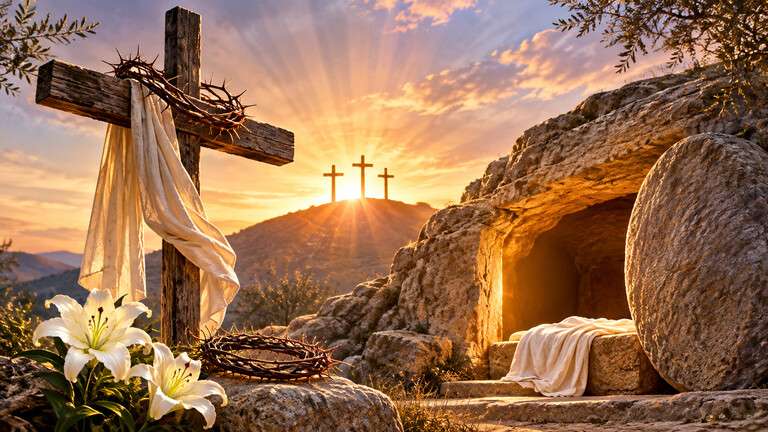
The very heart of Christian faith is not simply the belief that life exists after death. It is the belief that Jesus Christ died on the Cross, was buried, and rose on the third day, victorious over death. In Christian doctrine, the Resurrection of Christ is not merely a philosophical symbol of good triumphing over evil, nor a literary metaphor for the renewal of life. It is the foundation of Christian faith and its central proclamation. The Apostle Paul writes: “If in this life only we have hope in Christ, we are of all men the most pitiable. But now Christ is risen from the dead, and has become the firstfruits of those who have fallen asleep.” (1 Corinthians 15:19–20). To say that Christ is the firstfruits of those who have fallen asleep means that He is the first in the glorious Resurrection through which the way is opened for all who believe in Him. Just as death entered the world through sin, life, hope, and resurrection have been proclaimed to humanity through Christ. Therefore, Christians do not regard the grave as the absolute end. It is the place where the human body rests while awaiting the general resurrection of the dead.
Fourth: How Will the Dead Rise, and With What Kind of Body Will They Return?
Humanity has asked this question since the earliest ages. It was also raised by some believers in the early Church. The Apostle Paul addressed this mystery in Chapter 15 of his First Letter to the Corinthians, using the example of a grain of wheat planted in the ground. The seed that is buried in the soil does not reappear in precisely the same form in which it was planted. Instead, new life grows from it, and God gives it a body according to His will. The Apostle writes: “It is sown in corruption, it is raised in incorruption. It is sown in dishonor, it is raised in glory. It is sown in weakness, it is raised in power. It is sown a natural body, it is raised a spiritual body.” (1 Corinthians 15:42–44). Here lies one of the great mysteries of faith. Resurrection is not simply the return of the old body to its former earthly condition, with all its illnesses, pains, and signs of aging. Rather, it is God’s renewal of the human being, in which what is corruptible puts on incorruption, and what is mortal puts on immortality. The limited human mind cannot fully comprehend how this resurrection will take place. Yet faith rests upon the power of God, who created humanity out of nothing and is fully able to grant it a new and glorified life. The Apostle Paul concludes this chapter with a triumphant declaration: “Death is swallowed up in victory. O Death, where is your sting? O Hades, where is your victory?” (1 Corinthians 15:54–55).
Fifth: What Does a Human Being Take Along When Leaving This Life?
This is one of the most important questions every person should ask himself or herself, especially when attending a funeral or standing before the coffin of someone who, only yesterday, was walking, speaking, planning, working, accumulating wealth, and pursuing power and influence. I wish every person would attend a funeral once or twice a year and quietly reflect upon the scene—not merely as someone saying farewell to another person, but as someone looking at a picture of his or her own future. Imagine yourself in the place of the person resting in the coffin. Where is your money? Where are your positions and titles? Where are your possessions? Where are your disputes and hostilities? Where are your political and social victories? What has become of everything you spent years accumulating, defending, and boasting about? None of these things can be taken along. The body returns to the dust. Money remains for the heirs. Positions pass to others. Names become memories. What remains before God is the spiritual truth of the human being: faith, love, deeds, conscience, and the way one has treated others. Here we remember the parable of the foolish rich man, told by Jesus in the Gospel of Luke. He accumulated his crops and built larger storehouses, believing that his wealth would guarantee him many more years of comfort and enjoyment. But God said to him: “Fool! This night your soul will be required of you; then whose will those things be which you have provided?” (Luke 12:20). This is a clear warning to everyone who believes that money, power, and strength can protect them from death.
Sixth: The Final Judgment: Wealth Has No Value Before God’s Justice
Christian faith does not merely proclaim resurrection and eternal life. It also proclaims the reality of the final judgment, when every person will stand before God and be judged according to his or her life and deeds. Jesus explains this in the Gospel of Matthew through His description of the Last Judgment. When the Son of Man comes in His glory, He will separate people from one another, just as a shepherd separates the sheep from the goats. To those on His right, He will say: “For I was hungry and you gave Me food; I was thirsty and you gave Me drink; I was a stranger and you took Me in; I was naked and you clothed Me; I was sick and you visited Me; I was in prison and you came to Me.” (Matthew 25:35–36). When they ask Him when they did these things for Him, He answers: “Inasmuch as you did it to one of the least of these My brethren, you did it to Me.” (Matthew 25:40). These verses summarize the essence of Christian responsibility. Faith is not merely words. Prayer is not simply the repetition of phrases. Baptism is not merely a ritual. True faith must be transformed into love, generosity, mercy, forgiveness, and practical help for every person in need or suffering. Anyone who passes by a hungry person without helping, a sick person without asking after him, an oppressed person without defending justice, or a needy person while turning a blind eye to his suffering must reflect deeply on the words of Christ. God does not measure a person by wealth, fame, or authority, but by the love, mercy, justice, and faithfulness demonstrated throughout life.
Seventh: Death and the Eternal Encounter with God
The Apostle Paul teaches us that human existence on earth is temporary and that the true home of the believer is life with God. In his Second Letter to the Corinthians, he writes: “We have a building from God, a house not made with hands, eternal in the heavens.” (2 Corinthians 5:1). The earthly body, no matter how beautiful, strong, or healthy, remains a temporary tent. The believer’s hope, however, is to receive life that never ends. This does not mean that Christianity despises the body or rejects earthly life. On the contrary, Christianity believes in the dignity of the whole human person, body and soul, and looks forward to the resurrection and glorification of the body. After death, the human being stands before God for individual judgment. Thereafter comes the general resurrection and the final judgment at Christ’s glorious return. Thus, death is not merely separation from loved ones. It is also a reminder of our appointment with the Creator and of the fact that our earthly life is both a responsibility and a trust entrusted to us by God.
Eighth: Spiritual Death and New Life in Christ
There is a fundamental difference between physical death, which affects all human beings, and spiritual death, which results from turning away from God and surrendering to sin. A person may be physically alive yet spiritually dead because of hatred, bitterness, selfishness, greed, injustice, pride, and enslavement to sinful desires. Another person may be poor, sick, or physically weak, yet rich in faith, love, and hope, and close to God. Christ came to free humanity from the bondage of the old self—the person ruled by sin, passions, and selfish interests—and to offer the opportunity for spiritual rebirth through baptism, water, and the Holy Spirit. The Apostle Paul declares: “Therefore, if anyone is in Christ, he is a new creation; old things have passed away; behold, all things have become new.” (2 Corinthians 5:17). This is the life to which Christ calls us: a life of reconciliation with God, repentance, forgiveness, love, rejection of evil, and commitment to the truth.
Ninth: How Should a Believer Live, Knowing That One Day He Must Depart?
If death is inevitable, and if no human being knows the hour when God will call back the gift of life entrusted to him, why should we waste our years on hatred, quarrels, wars, and struggles for money, power, and influence? Why allow pride to control us, selfishness to blind us, and hatred to steal our peace? Reflecting on death should not lead us to despair or unhealthy fear. Rather, it should lead us to wisdom, humility, and a deeper awareness of the value of time and life. We should live each day as though it might be our last—not by surrendering to the thought of death, but by remaining prepared to meet God. We should forgive before it is too late, love before we lose those we love, help others while we still have the opportunity, reconcile with those who have wronged us and those whom we have wronged, and turn away from everything that separates us from God. Let us always remember the invitation of Jesus Christ: “Come to Me, all you who labor and are heavy laden, and I will give you rest.” (Matthew 11:28). The believer does not face the pains of life and the fears of death alone. He lives with the hope that God is with him, that God’s love is stronger than every suffering, and that His promise of eternal life will never fail.
Conclusion: We Do Not Simply Die; We Fall Asleep in the Hope of Resurrection
From the Egyptian pyramids, built as royal tombs, to the burial grounds and funerary rituals of the Phoenicians, and through the ancient civilizations that searched for immortality, humanity has continued to ask the same question: Is death the end? The Pharaohs sought the afterlife through mummification and funerary rituals. The Phoenicians were concerned with the destiny of the soul and its passage into the realm of the ancestors. Christianity, however, proclaimed that God Himself entered human history, became incarnate in the person of Jesus Christ, accepted death on the Cross, and rose victorious on the third day. This is the fundamental difference between ancient beliefs and Christian faith: resurrection is not a human project designed to achieve immortality. It is a divine promise fulfilled in Jesus Christ, who declared: “I am the resurrection and the life. He who believes in Me, though he may die, he shall live.” (John 11:25). We do not deny the reality of physical death, ignore the pain of separation, or pretend to know all its mysteries. But we believe that death is no longer the absolute end, because Christ has opened the way to resurrection and eternal life.
The body returns to the dust, but the human person cannot be reduced to an earthly body. The soul is in the hands of its Creator, and Christian hope looks forward to the resurrection of the dead on the Last Day, when what is corruptible will put on incorruption and what is mortal will put on immortality. Ultimately, one truth must never be forgotten: authority does not last, wealth does not remain, power cannot protect its possessor, and no human being can escape the hour of departure.
What remains is God, His Word, His promises, the hope of resurrection, and the eternal life He has prepared for those who love Him.
We do not live merely to die. We live in the hope of passing from death into life and of meeting our Lord Jesus Christ in the Kingdom of His Father, where there will be no pain, no sorrow, and no sighing, but everlasting life that will never pass away. “I am the resurrection and the life.” (John 11:25)