Palestinians need more negotiators, not arms
By: Camelia Entekhabi-Fard /Asharq Al Awsat
Wednesday, 30 Jul, 2014 .
Not long ago, perhaps less than a decade ago, I was one of those Iranians who viewed the Palestinians as terrorists and opportunists. As somebody who was born and raised in Iran, I can confidently tell you that this view is prevalent; there are many Iranians who viewed, and continue to view, the Palestinians in this way. Tehran is one of the biggest supporters of the Palestinian Hamas movement, and the same goes for Lebanon’s Hezbollah militia, and ultimately it is the Iranian government’s support for such organizations that creates this feeling among the Iranian public. Iran’s state media coverage regarding the Palestinian–Israeli conflict is characterized by propaganda. The Iranian people have not had the opportunity to hear the real story and to view what is happening to the Palestinian people from a moral standpoint. This gives rise to the prevalent view among the Iranian general public of Hamas as an opportunistic group that is coming to Iran for finances and seeking to embroil Tehran into the conflict.
The Iranian public are angered by the regime spending so much money on Hamas and Hezbollah when so many Iranian people themselves are living in poverty. Iranian society respects the principle of helping others, but there are other considerations that must be taken into account. Iran’s international prestige has been severely damaged by the Islamic Republic’s support of these militias, not to mention the sheer amount of money it has lost. I could tell you that when I was living in Iran, I was more sympathetic towards the Israelis than the Palestinians. The same goes for many other Iranians I was in contact with in Tehran during this period. The Iranian public’s knowledge about the Palestinian–Israeli conflict is miniscule; everything the Iranian people know about it comes directly from the regime. This represents Tehran’s interpretation of events, which they put forward to serve their own interests.
However, I ultimately changed my view about the Palestinian–Israeli conflict after I moved from Iran to the US. I studied International Affairs at New York’s Columbia University, and this brought about a change in my assessment of the situation. It’s interesting to see that the prevalent view among intellectual Americans is one of support for the Palestinians and condemnation of Israel. This support doesn’t have anything to do with Hamas or Fatah, but rather it’s a democratic call for Israel to end its occupation of Palestinian territories and abide by the UN Security Council resolution, which calls for Israel to withdraw to the pre-1967 borders. It was in the US that I learnt, and continue to believe, that the Palestinians are not a bunch of terrorists who represent a threat to Israeli peace and stability.
This brings us to the current round of conflict between Israel and Palestine, which has seen more than 1,000 Palestinians killed in the Israeli aggression against Gaza. As I write this op-ed, this conflict is ongoing, with all attempts to reach a lasting ceasefire ending in failure.
I am sure that many people in Iran are heartbroken by the sight of defenseless Palestinian women and children with no place to hide from the Israeli air strikes on Gaza. The one party that seems to be doing everything to bring about a desired ceasefire is US Secretary of State John Kerry, and not the Iranian side, unfortunately.
Speaking in late July, Iranian Supreme Guide Grand Ayatollah Ali Khamenei appeared to call for the West Bank to follow the approach being taken by Hamas in Gaza—namely, to pick up arms and fight Israel. During a speech to university students on July 23, Khamenei said: “Our belief is that the West Bank should be armed like Gaza. Those who love the fate of the Palestinians, if they can do something, this is it. The people there [West Bank] should be armed. The only thing that can uproot the distress of the Palestinians . . .[is] to have the strongest hand. It is to show strength.”
Following Khamenei’s comments, the Iranian, Arab and international media ignited, asking whether it would be better to seek a ceasefire, or fight as Khamenei urged.
Mohammed Reza Shah Pahlavi, the last Shah of Iran, truly sought to help the Palestinian people, and some argue that if he were not ousted by the 1979 Islamic revolution, he would have played a major role in ending this conflict. However the Islamic Republic of Iran has a different regional goal than that of the former Iranian monarchy. There has been no communication between Tehran and Tel Aviv; in fact, Iran and Israel are each other’s greatest enemy. If US President Barack Obama believes so strongly in the diplomatic approach, to the point that he has angered Tel Aviv—one of America’s closest allies—by making up with Iran over the nuclear dossier, then why can’t he enforce peace between Palestine and Israel? On the other hand, Iran has the financial and military resources to continue supporting Hamas and Hezbollah and play the role of spoiler in the Middle East if they so choose. However, how long will they continue to choose to do so?
Edward Said, one of the greatest Palestinian–American intellectuals of our time, focused on the lack of communication between Washington and the Arab world when dealing with the Palestinian Cause. Culture and Resistance: Conversations with Edward W. Said quotes Said as saying that “the absence of initiative” is “our greatest enemy.”
The Palestinians don’t need more arms, they need more negotiators. Communication is the key.
Uzay Bulut/Gatestone Institute/Turkey: Erdogan Pledges to Convert Byzantine Cathedral Hagia Sophia into a Mosqueأوزاي بولوت/معهد جيتستون: الرئيس التركي أردوغان يتعهد بتحويل الكاتدرائية البيزنطية آيا صوفيا إلى مسجد
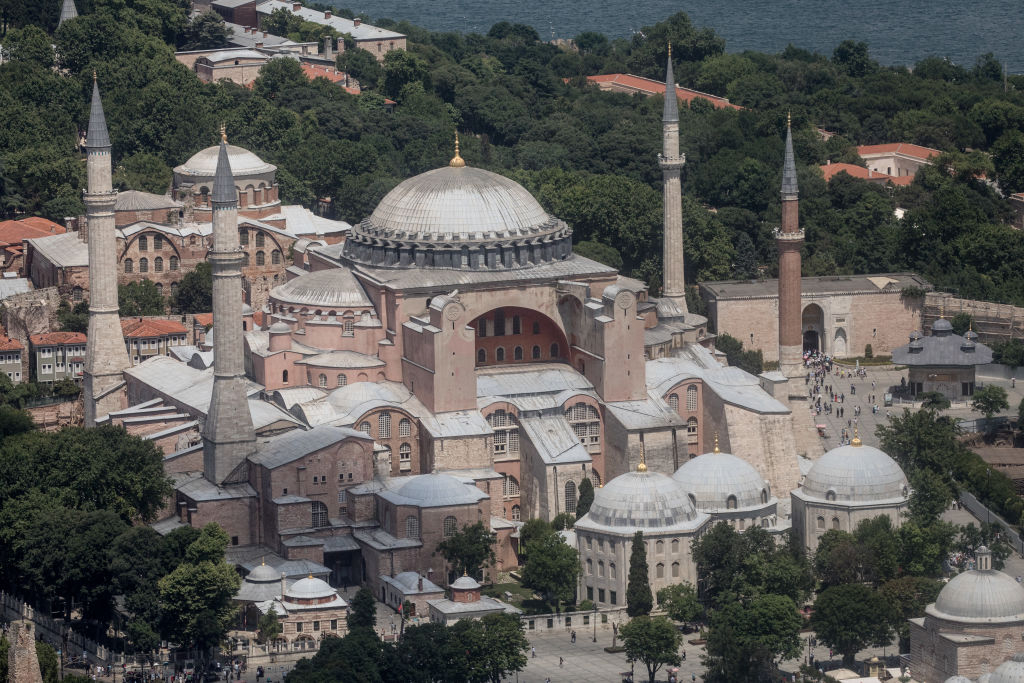
ISTANBUL, TURKEY - JUNE 20: Istanbul's famous Hagia Sofia is seen during a Kaan Air helisightseeing tour on June 20, 2018 in Istanbul, Turkey. Presidential candidates from all parties are holding campaign rallies across Turkey a week ahead of the countries June 24, parliamentary and presidential elections. (Photo by Chris McGrath/Getty Images)
Turkey: Erdogan Pledges to Convert Byzantine Cathedral Hagia Sophia into a Mosque أوزاي بولوت/معهد جيتستون: الرئيس التركي أردوغان يتعهد بتحويل الكاتدرائية البيزنطية آيا صوفيا إلى مسجد
Uzay Bulut/Gatestone Institute/April 07/19
“When Constantinople fell to the Ottoman Turks in 1453, virtually all of the city’s surviving cathedrals and churches were — after being desecrated and thoroughly plundered — forcibly seized and turned over to the Turks’ religious establishment to be converted to mosques and used as Muslim properties.” — Dr. Alexandros K. Kyrou, professor of history, Salem State University.
Nine other former Hagia Sophia churches are either being used as mosques already or are in the process of being renovated for this purpose. The youngest of these, in Trabzon, was converted into a mosque in 2013. — Ersoy Soydan, assistant professor of communications at Kastamonu University and author of Churches and Monasteries in Turkey
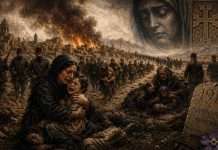
Sadly, Turkey’s Greek community as a whole, let alone that of Istanbul by itself, is not sizeable enough to oppose or protest infringements on their historic cathedral. The 1914-1923 genocide of Greek Christians in Anatolia, and subsequent atrocities against the survivors — such as the 1955 anti-Greek pogroms in Istanbul — have almost completely wiped out the region’s Greek populace.
Turkish President Recep Tayyip Erdogan recently announced plans to convert the Hagia Sophia museum, originally a Byzantine cathedral, into a mosque. (Photo by Chris McGrath/Getty Images)
Addressing a rally ahead of the March 31 municipal elections in Turkey, President Recep Tayyip Erdogan announced plans to convert the Hagia Sophia museum, originally a Byzantine cathedral, into a mosque.
Erdogan repeated this statement the following day during a televised interview. “Hagia Sophia will no longer be called a museum,” he declared. “Its status will change. We will call it a mosque.”
Erdogan took the opportunity to respond to foreign officials critical of his intention to violate the former church by venting against Israel.
“Those who remain silent when Al Aqsa mosque is attacked, trampled [and] its windows smashed cannot tell us what to do about the status of Hagia Sophia,” he said, referring to clashes between Palestinian-Arab rioters and Israeli police on the Temple Mount in Jerusalem, the holiest site in Judaism and the location of the Al Aqsa mosque.
Hagia Sophia, however, has nothing to do with either Al Aqsa or Israel. Destroying churches to use as mosques is also not new to Turkey, both during and preceding Erdogan’s rule. Islamic supremacists have, in fact, been engaging in this practice since the Turkish invasion and takeover of Asia Minor in the 11th century.
Hagia Sophia (Greek for “Holy Wisdom”) was built in the 6th century in Constantinople — today’s Istanbul — and remained the world’s largest cathedral for nearly 1,000 years, until the Ottoman Turks conquered the city and looted it.
Dr. Alexandros K. Kyrou, professor of history at Salem State University, recounts:
“When Constantinople fell to the Ottoman Turks in 1453, virtually all of the city’s surviving cathedrals and churches were — after being desecrated and thoroughly plundered — forcibly seized and turned over to the Turks’ religious establishment to be converted to mosques and used as Muslim properties. The conquering sultan, Mehmet II, personally oversaw the conversion of Hagia Sophia. Crosses were demolished and exchanged for crescents, altars and bells were destroyed, icons were burned or hacked to pieces, mosaics and frescoes depicting Christian imagery were plastered over, and most of the cathedral’s priests were killed or enslaved. In time, four colossal minarets were erected to surround Hagia Sophia, producing the iconic image that has come to be globally associated with Ottoman Constantinople and Turkish Istanbul…
“Indeed, the purpose for the construction of the massive minarets that now tower over Hagia Sophia was to project to the world Islam’s triumph over Christendom’s greatest empire, city, and church. The capture of Hagia Sophia confirmed and symbolized in the Ottomans’ imagination their belief in the superiority of their state and faith over all other nations and all religions, a putative affirmation of their providential role and destiny in history. Hence, the Ottomans formally dedicated their greatest, most celebrated single piece of loot — Hagia Sophia — as Great Fatih Mosque, or ‘Great Conquest Mosque.'”
The Turkish Republic, established in 1923, changed the name of Constantinople to Istanbul in 1930, and, under the first president Mustafa Kemal Ataturk, turned the city’s Hagia Sophia mosque into a museum in 1935 — but not back to a church. For at least the last six years, however, Turkish officials have been talking about their desire to reconvert it into a mosque.
In 2013, Turkey’s then-deputy prime minister, Bülent Arınç, told reporters that he hoped to see Istanbul’s Hagia Sophia Museum used as a mosque. In 2016, Turkish authorities announced that readings from the Koran would be broadcast from Hagia Sophia during Islam’s holy month of Ramadan, spurring the government to appoint a permanent imam who would lead five daily Islamic prayers at the site.
The Hagia Sophia in Istanbul is not the first former Hagia Sophia church (and later museum) to be converted into a mosque in Turkey. According to Ersoy Soydan, assistant professor of communications at Kastamonu University and author of Churches and Monasteries in Turkey, nine other former Hagia Sophia churches are either being used as mosques already or are in the process of being renovated for this purpose. The youngest of these, in Trabzon, was converted into a mosque in 2013.
Sadly, Turkey’s Greek community as a whole, let alone that of Istanbul by itself, is not sizeable enough to oppose or protest infringements on their historic cathedral. The 1914-1923 genocide of Greek Christians in Anatolia, and subsequent atrocities against the survivors — such as the 1955 anti-Greek pogroms in Istanbul — have almost completely wiped out the region’s Greek populace.
*Uzay Bulut, a Turkish journalist, is a Distinguished Senior Fellow at Gatestone Institute.