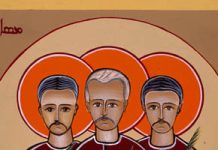
Saint Edmund the Martyr- King of England Who Chose Martyrdom Rather Than Denying Christ
Elias Bejjani/November 20/2026
Introduction
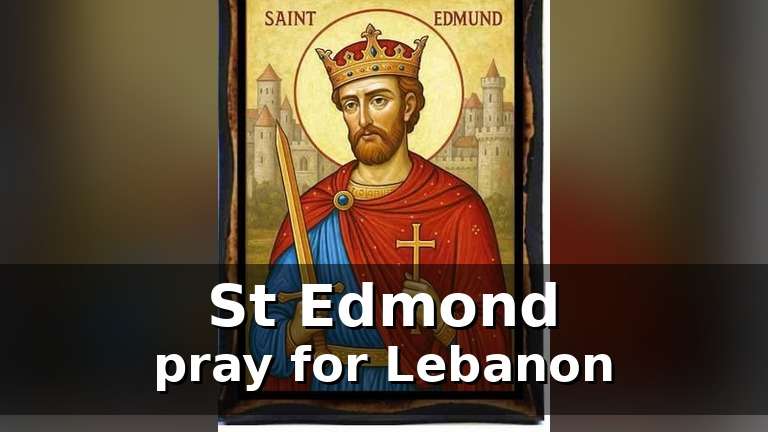
On November 20, the Church commemorates Saint Edmund, King of East Anglia, who was martyred in 869 AD for defending his Christian faith. He is one of the prominent figures in the history of English Christianity and has become a symbol of courage, steadfastness, and unwavering loyalty to Christ.
His Birth and Origins
According to traditional accounts, Edmund was born around 841 AD. However, his birthplace and family origins remain historically uncertain. Later accounts claim that he was born in Nuremberg, Germany, and was the son of a Saxon king named Alcmund. Nevertheless, historians do not regard these details as firmly established. It is more likely that he was of Anglo-Saxon origin and connected to East Anglia.
His Accession to the Throne
Edmund ascended the throne of East Anglia on December 25, 855, when he was approximately fourteen years old. His traditional biography portrays him as a just ruler, devoted to prayer, concerned for his people, and free from arrogance, malicious intrigue, and the abuse of power.
According to religious tradition, he memorized the entire Book of Psalms. This detail belongs to the traditional accounts of his life, although no contemporary evidence has been found to establish it.
When and Why Did He Embrace Christianity?
We do not know the exact date of Edmund’s baptism or the year in which he embraced Christianity. Nor do the earliest historical sources provide a documented account of his conversion. It is likely that he was raised in a Christian environment and was already a Christian before becoming king.
What his ecclesiastical tradition emphasizes, however, is the depth of his devotion to Christ. His faith was not merely a social or inherited tradition; it was a fundamental principle that he refused to compromise, even when faced with death.
His Era and the Viking Invasions
The ninth century witnessed widespread Scandinavian invasions of the Anglo-Saxon kingdoms. The force known as the Great Heathen Army arrived in England in 865 and returned to East Anglia in 869.
Edmund found himself confronting an invasion that threatened his kingdom, his people, and their independence.
His Martyrdom on November 20/869 AD
Early historical sources report that Edmund fought against the Danes, who defeated him, killed him, and seized his kingdom.
However, the ecclesiastical account written by the monk Abbo of Fleury around 985–987 AD relates that Edmund was captured and refused to abandon Christ or submit to the demands of the pagan invaders.
According to this account, his captors tied him to a tree and shot him with arrows before beheading him.
Thus, he became remembered in Christian tradition as a martyr king—not simply because he died in battle, but because, according to the Church’s account, he refused to deny Christ in order to save his life.
His Miracles and the Traditions Associated with Him
One of the best-known traditions associated with Saint Edmund concerns his head and a she-wolf.
According to the legend, after the invaders beheaded him, they threw his head into a forest among the thorns. When his followers began searching for it, they heard a voice calling out: “Hic, hic, hic,” meaning “Here, here, here.”
The story relates that they eventually found his head guarded by a large she-wolf. They then reunited it with his body, and, according to the miraculous account, it became joined to the body once again.
His shrine at Bury St Edmunds also became associated with numerous accounts of healing, protection, and answered prayers. It developed into an important center of Christian pilgrimage.
These accounts form part of the religious tradition surrounding the saint, although not all of them are
Historically verifiable events.
His Achievements and Historical Influence
Saint Edmund became an example of a Christian ruler who placed justice and responsibility above personal interests.
His legacy includes:
Becoming a symbol of unwavering faith and refusing to deny Christ.
Gaining widespread veneration in the late ninth century, as demonstrated by commemorative coins bearing his name.
Having his relics transferred to Bury St Edmunds around the beginning of the tenth century.
Becoming associated with the development of a major Benedictine abbey, which turned the location into an important pilgrimage center.
Earning the respect of English kings and becoming one of England’s most important patron saints during the Middle Ages.
When Was He Canonized?
There is no known exact date for Saint Edmund’s formal canonization, nor is there a record of a pope issuing an official decree declaring him a saint.
This is because he lived before the establishment of the centralized papal canonization system familiar today.
Nevertheless, devotion to him began relatively soon after his martyrdom, and his recognition as a saint became firmly established in the English Church during the tenth and eleventh centuries.
He served as one of England’s principal patron saints before Saint George gradually assumed that position in the mid-fourteenth century.
Spiritual Lessons
The life of Saint Edmund offers us several important spiritual lessons:
Faith in Christ is not negotiable. Our loyalty to God must remain stronger than our fear of suffering or death.
Authority is a responsibility to serve the people, not a personal privilege. Leadership must be guided by justice, integrity, and concern for others.
True courage means standing firm for what is right despite fear and suffering.
One must never sacrifice conscience and dignity merely to secure personal survival.
Witnessing to Christ means bearing witness to truth, love, and freedom.
Edmund lost his crown and his earthly life, but he remains in Christian memory an enduring example of faithfulness to God.
A Prayer for Lebanon’s Deliverance Through the Intercession of Saint Edmund the Martyr
O Lord, our God, through the intercession of Saint Edmund the Martyr, we humbly implore You to have mercy on Lebanon, the Land of the Cedars, a land of faith and holiness, and to deliver it from injustice, corruption, occupation, subservience, and illegal weapons.
O Lord, liberate Lebanon from all those who undermine its sovereignty and threaten its peace and national identity. Establish within it a free, independent, and just state, governed by the rule of law and protected by its legitimate national army.
Grant its people patience and hope. Protect its sons and daughters, its churches, and its Christian heritage. Shield its youth from emigration and despair, and restore security, peace, and dignity to its homes.
O Saint Edmund the Martyr, you who chose faithfulness to Christ over your own life, intercede for Lebanon and ask God to grant it the blessings of deliverance, freedom, sovereignty, and peace.
O Lord, have mercy on Lebanon, bless it, and deliver it. Amen.
O Lord, through the intercession of Saint Edmund, save Lebanon, bless it, protect it, and restore its sovereignty, independence, and peace.
We offer You this prayer in the name of the Father, and of the Son, and of the Holy Spirit, one God. Amen.
Saint Edmund the Martyr, pray for us.
O Lord, save Lebanon. Amen.
Note: The information contained in this study is compiled from numerous documented ecclesiastical, theological, academic, and media sources.
Historical References:
Vatican City State – Saint Edmund, King and Martyr, 20 November 2026.
Abbey of St Edmund Heritage Partnership – Who Was Saint Edmund?
Cambridge University Press – St Edmund’s Medieval Lives.
Catholic Encyclopedia – St Edmund the Martyr.