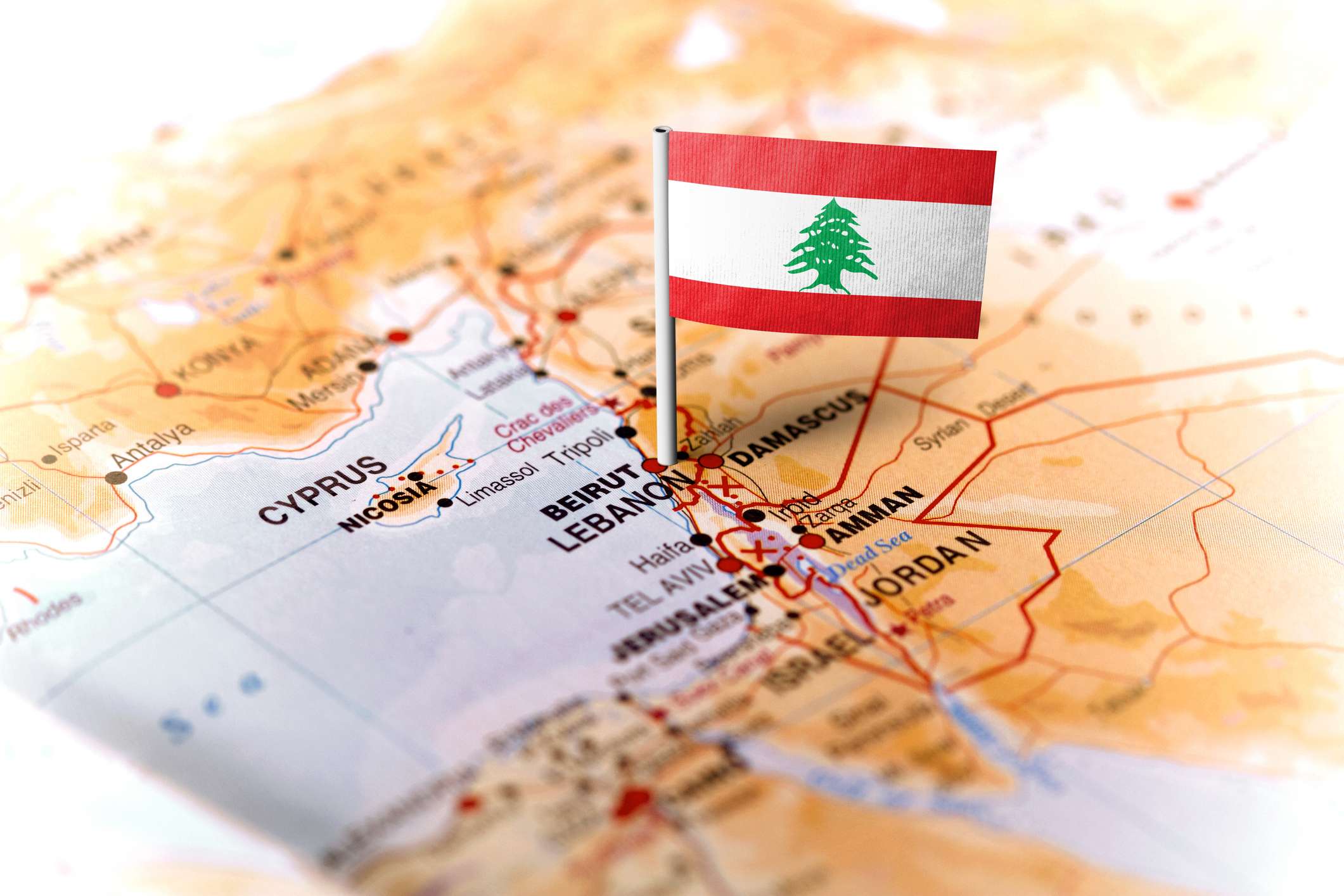
The flag of Lebanon pinned on the map. Horizontal orientation. Macro photography.
The Strangers in the Streets: Hezbollah, the War That Made It, and the Stages of Its Unraveling By: Makram Rabah/Hover Institution/May 19/2026
In the aftermath of the 1982 Israeli invasion of Lebanon, as West Beirut struggled not only to absorb the scale of its physical devastation but also to grasp the deeper collapse of the political order that had once given the country a semblance of coherence, something unfamiliar began to emerge from within the fractured landscape. It did not merely resemble the militias that had already come to define the war years.
In the aftermath of the 1982 Israeli invasion of Lebanon, as West Beirut struggled not only to absorb the scale of its physical devastation but also to grasp the deeper collapse of the political order that had once given the country a semblance of coherence, something unfamiliar began to emerge from within the fractured landscape. It did not merely resemble the militias that had already come to define the war years. It suggested the arrival of a different kind of actor altogether, one that spoke a different language, moved with a different discipline, and, perhaps most importantly, imagined a different society. Beirut had already grown accustomed to armed groups, to ideological militancy, to young men invoking revolution and liberation while navigating a terrain of checkpoints, ruins, and shifting front lines. Yet what appeared in those years was not simply another faction competing for ground in the chaos. It was a formation that sought to regulate that chaos, to reshape it, and ultimately to impose its own order upon it.
They were bearded, austere, often rigid in both demeanor and appearance, and they did not confine their activities to the battlefield because for them the battlefield extended into everyday life, into neighborhoods, into customs, into gender codes, into the very definition of what it meant to belong. Liquor stores were bombed not because they represented foreign occupation, but because they violated an emerging moral order. Women who refused to conform to imposed standards were harassed and assaulted, with acid, not as political adversaries, but as signs of social deviation. What was unfolding in Lebanon in those years was not simply a military phenomenon.
It was the embryonic form of a social and ideological project that would soon harden into something far more durable than an ordinary militia. By the time Hezbollah formally announced itself in 1985, that project had already acquired enough coherence to leave little room for misunderstanding, and its founding document remains one of the clearest texts for understanding the movement not as it later wished to be seen, but as it originally defined itself.
Stage One: The Incubation of War
In their open letter addressed to the Downtrodden in Lebanon and World, Hezbollah spoke in expansive and unambiguous terms, declaring:
We are the sons of the nation of Hezbollah, whose vanguard God granted victory in Iran, where it reestablished the nucleus of the central Islamic state in the world. We are committed to the commands of a single leadership, embodied today in a wise and just authority represented by the qualified Jurist—the Guardian (Wilayat al-Faqih)—may his shadow be prolonged: Ruhollah al-Mousawi al-Khomeini, the rightly guided Imam, the Grand Ayatollah.
This was not the language of a localized resistance movement concerned only with the recovery of territory or the defense of a national border. It was the language of incorporation into a broader ideological order, one that placed authority outside Lebanon, one that subordinated the local to the transnational, and one that defined its purpose not through the logic of state sovereignty but through the logic of revolutionary continuity. For an outside observer, particularly one inclined to reduce Middle Eastern armed movements either to anti-occupation insurgencies or simple foreign proxies, this distinction matters enormously. Hezbollah was never simply a proxy in the narrow conventional sense, nor was it merely an insurgency reacting to occupation. From its inception it was an instrument embedded within a larger architecture of power, one that used Lebanon’s collapse not as a tragic backdrop but as fertile ground.
It is here that the insight of Lokman Slim, one of Hezbollah’s harshest critics gunned down by the group in 2021 becomes indispensable, because Slim refused the comforting falsehood that Hezbollah could be understood primarily as the child of resistance. He insisted, with the clarity that so often made his interventions both devastating and difficult to ignore, that Hezbollah was not the child of resistance but the child of civil war. That formulation is not a slogan. It is a methodological correction. It reorients the entire story away from the mythology Hezbollah later built around itself and back toward the conditions that made its rise possible. It asks us to look not first at Israel, nor even at Iran, but at the internal collapse of Lebanon’s political order, at the long process by which sovereignty thinned out while the shell of the state remained standing. Civil war in this reading did not merely create chaos. It created a political environment in which the state survived as a façade while authority was redistributed among militias, foreign armies, intelligence services, parties, sectarian bosses, and revolutionary intermediaries. In such an environment, actors like Hezbollah do not appear as exceptions. They appear as logical products.
Slim’s 2018 lecture entitled Deciphering Hezbollah on war, Iraq, Iran, and the birth of Hezbollah remains one of the sharpest articulations of this point. He begins from what appears to be a simple premise but is in fact a foundational one: in civil wars that take place in countries theoretically governed by central governments, the sovereignty of those governments shrinks and contracts. In the Lebanese case this truth was especially stark. When people think of the Lebanese Civil War and the erosion of Lebanese sovereignty, they think first of the PLO, of Syria, of Israel. But Slim reminds us that another major actor is often forgotten, and that forgetting is not accidental.
It obscures the true ecology of war from which Hezbollah emerged. Iraq, and specifically Saddam Hussein’s Iraq, had a deep, organized, and significant presence in Lebanon long before Hezbollah formally declared itself. It had allies, parliamentary representation through the Ba’ath, links to Palestinian organizations such as the Arab Liberation Front, and a real foothold in Lebanese political life. To understand the rise of Hezbollah, one must first recover this more crowded field. Lebanon was never a stage on which only one or two foreign powers competed. It was a revolving door of actors entering and exiting, each seeking clients, influence, legitimacy, and armed leverage.
Iran’s presence in Lebanon during those crucial years was also more elusive than later narratives suggest. Slim notes that it is in many ways harder to trace Iran’s early role than Iraq’s, even though Iran would become far more decisive in the long run. There are several reasons for this. The first is that before the overthrow of the Shah, Iran’s presence did not yet take the form that it would later assume under Khomeinism. The second is that the period between the fall of the Shah in 1979 and the consolidation of Khomeinist control by 1981 was itself a period of internal Iranian contestation, and those contests were reflected abroad, including in Lebanon. The third is Syria’s own ambiguous policy under Hafez al-Assad, which complicated the mapping of Iranian activity. In other words, Iran did not descend upon Lebanon in a fully consolidated ideological form. Its early involvement was fragmented, personalized, and partially concealed. Slim makes a striking point when he says that in remembering that period people often remember names rather than organizations. They recall figures such as Hossein Ali Montazeri or Mohammad Montazeri, but not always the precise structures through which Iranian influence operated. This matters because it reminds us that Hezbollah began not as a fully visible institution but as an assemblage of networks, relationships, clerics, intermediaries, armed cells, and ideological committees.
Stage Two: Shadow Formation
This brings us to the second stage of Hezbollah’s evolution: the stage of shadow formation. Before Hezbollah declared itself, before it became a recognized brand, it existed as a process of coordination, ideological preparation, and armed experimentation. The Israeli invasion of 1982 accelerated this process, but it did not invent it. That invasion certainly shattered what remained of the Lebanese order in Beirut and South Lebanon, but the project that would become Hezbollah was already gathering shape through a convergence of Iranian revolutionary ambition, Syrian strategic permissiveness, and local social transformation inside parts of the Shiite community. What made the period so important was not merely that Israel invaded, but that invasion interacted with an already fractured domestic scene. This allowed a new actor not only to fight but to define itself as morally and politically superior to the older currents around it.
The mythology of Hezbollah has always depended on presenting its formation as a direct, organic answer to occupation. That myth is politically effective because it simplifies causality. It says: there was invasion, therefore there was resistance. Yet the historical record, and Slim’s intervention in particular, makes clear that the truth is both darker and more revealing. The early Khomeinist networks in Lebanon were not simply preparing to resist Israel. They were also preparing to reorder the Shiite political field itself. Slim is blunt on this point. He argues that the war between Iraqi and Iranian influence on Lebanese soil, often trivialized in memory as the so-called “War of the Embassies,” was not merely a spectacle of foreign missions clashing. It marked the beginning of what he explicitly calls political cleansing within the ranks of Lebanese Shiites. That phrase is crucial. The process was not incidental. It was constitutive.
Stage Three: The Elimination of Competitors
Here, then, lies the third stage: the elimination of competitors. Before Hezbollah could become the dominant expression of Shiite politics in Lebanon, the pluralism of that space had to be broken. Iraqi influence had to be pushed out. Ba’athist currents had to be destroyed or marginalized. Leftist and communist influences had to be contained. Independent Shiite voices who did not fit the emerging ideological mold had to be intimidated, isolated, or removed. Slim names this directly when he recalls the killings of prominent Shiites figures like Riyad Taha and Musa Shuayb and evokes the broader pattern in which others, not necessarily Ba’athists and not necessarily tied to Iraq, were also swept aside. The point is not to assign every killing mechanistically to one center, but to understand the political logic of the moment. A new ideological order cannot consolidate in a crowded field unless that field is narrowed. Hezbollah did not inherit an empty communal space. It had to create one.
This is where the relationship with the Amal Movement must also be understood with precision. Too often the history is flattened into a neat succession in which Amal represented an earlier Shiite mobilization and Hezbollah a later, more radical alternative. But the reality was messier and more revealing. As Slim notes, there was no formal Hezbollah yet in the full sense, and Amal itself had become a site of contestation, institutional weakening, and instrumentalization. It was not simply that Hezbollah emerged after Amal. Rather, Amal in certain moments functioned as a vessel, a terrain, or a compromised intermediary through which parts of the Iranian project could move before a distinct Hezbollah identity was fully declared. To recognize this is not to collapse the two movements into one another, but to see that the prehistory of Hezbollah runs through the fragmentation and repurposing of existing Shiite institutions. What we later call Hezbollah did not leap fully formed into existence. It coalesced through infiltration, duplication, ideological selection, and the gradual creation of parallel loyalties.
Stage Four: Ideological Revelation
If the first stage of Hezbollah’s evolution was the contraction of sovereignty, the second its shadow formation within a shattered landscape, and the third the liquidation of opponents, then the fourth stage was ideological revelation. This came with the 1985 Open Letter, but the importance of that document is often misunderstood. It was not a beginning. It was a declaration of something already underway. By the time Hezbollah announced itself publicly, the movement had already established enough armed, clerical, and social presence to define itself in maximal terms. This is why the document matters so much. It does not speak like a movement improvising under duress. It speaks like one already confident in its place within a larger revolutionary chain of command. The document placed Wilayat al-Faqih at the center, rejected the legitimacy of Western influence, condemned the Lebanese political system, and framed Hezbollah as part of a historical and theological struggle larger than Lebanon itself. This was the moment when the child of civil war named itself and did so without embarrassment.
To say that Hezbollah was born of war rather than resistance does not mean occupation was irrelevant. Occupation gave the movement rhetorical power, operational opportunity, and real targets. It allowed Hezbollah to fuse social discipline with military action in a way that older actors could not. But occupation alone cannot explain why Hezbollah took the form it did, why it developed the organizational culture it did, why it insisted on subordination to an external religious-political authority, or why it devoted so much energy not only to fighting Israel but to policing its own community and eliminating alternative political expressions within it. Resistance can explain part of Hezbollah’s appeal. It cannot explain the fullness of its project, Civil war can.
Stage Five: Strategic Exceptionalism
The fifth stage in Hezbollah’s evolution came after the formal end of the Lebanese Civil War (1975-1990) with the Taif Agreement. This is the stage that might be called strategic exceptionalism. It is perhaps the most consequential stage of all because it is where Hezbollah ceased being merely a wartime formation and became a durable political structure. Taif ended the war in name and disarmed most militias in practice, yet Hezbollah retained its arsenal under the justification that it was not a militia but a resistance movement. This single asymmetry would shape postwar Lebanon more than perhaps any other arrangement. While other actors were folded into the state, diminished by it, or neutralized through its institutions, Hezbollah was allowed to preserve the very instrument that gives any armed actor real political leverage: an autonomous monopoly over organized violence inside its own domain.
This phase is often described in the language of pragmatism, as though Hezbollah simply took advantage of a loophole in the postwar settlement. But that description is too thin. What actually happened was that the wartime logic identified by Slim was preserved under a peacetime façade. The state returned, but not really. Institutions reopened, elections resumed, ministries functioned, reconstruction began, and downtown Beirut rose from the rubble. Yet beneath this apparent return of normal life, one crucial wartime exception remained intact. Hezbollah’s weapons meant that war had not really ended. The condition of exception was merely redistributed. Slim’s point that war is Hezbollah’s incubating environment and the condition of its survival becomes especially important here. War, in this sense, does not need to exist only as literal frontline combat. It can persist as a governing condition, as a permanent rationale, as a deferred emergency, as a structure of suspended sovereignty. Hezbollah survived Taif not because peace failed to arrive, but because peace arrived in a partial, compromised, and uneven form that still left intact the logic of exceptional arms.
During this postwar period Hezbollah displayed extraordinary strategic patience. Unlike many Lebanese actors, it did not rush to assume the burdens of full governance. It let others manage the corruption, compromise, and public resentment that came with state administration while it built a parallel order of its own. Amal and Nabih Berri, elected speaker in 1992, absorbed much of the representational labor within formal politics. The Syrian regime managed the broader architecture of coercion and elite bargaining. Hezbollah, meanwhile, concentrated on constructing a dense ecosystem of schools, clinics, welfare associations, media platforms, religious institutions, local municipal influence, charitable networks, and cadre formation. This was not merely constituency service. It was the conversion of wartime loyalty into long-term social infrastructure.
That social infrastructure also tells us something about Hezbollah’s internal self-understanding. Movements born in insurgency often romanticize decentralization, improvisation, and heroic sacrifice. Hezbollah certainly cultivated martyrdom and discipline, but its deeper genius lay elsewhere. It was organizational. It built systems. It catalogued families, managed payments, standardized rituals, cultivated internal memory, and turned community management into a sophisticated apparatus. This is why later revelations such as the exposure of its logistical systems and even something as mundane-sounding as its central kitchen matter so much. They reveal not just operational detail but institutional character. Hezbollah ceased long ago to be simply a guerrilla movement. It became a bureaucratized armed order, a state within a state not only in military terms, but in provisioning, welfare, socialization, and everyday governance.
Stage Six: Permanent Resistance After Liberation
The sixth stage came with the year 2000 and the Israeli withdrawal from South Lebanon. Here Hezbollah confronted what should have been a strategic contradiction. If resistance had been built around liberation from occupation, then Israel’s withdrawal ought to have forced a transition from revolution to statehood, from exception to normalization. Instead, Hezbollah transformed victory into a new basis for continued exception. It claimed the withdrawal not as the fulfillment of its mission, but as proof of the necessity of preserving its arms. Resistance became less a temporary instrument than a permanent identity. This was a critical shift. The organization no longer needed occupation in its earlier form. It needed only the perpetual possibility of conflict, along with contested points such as Shebaa Farms, detainees, violations, and broader regional confrontation, to sustain the argument that disarmament would be premature and dangerous. In other words, the end of one chapter of conflict became the justification for keeping the entire wartime architecture alive.
This is precisely why Slim’s warning remains so sharp. If one accepts the premise that Hezbollah is the child of resistance, then Israeli withdrawal should have clarified its future: the movement would either demilitarize or transform into a normal political force. But if one recognizes that Hezbollah is the child of war, then the opposite becomes legible: any step toward normalcy becomes a threat to its reason for existing as an autonomous armed entity. It is not resistance that must be preserved, but the condition that makes resistance endlessly necessary. War, understood as a permanent exception, becomes the oxygen of the organization.
Stage Seven: Forced Visibility and Domestic Coercion
The assassination of former Prime Minister Rafik Hariri in 2005 marked the beginning of the seventh stage- forced visibility. Up until then Hezbollah had benefited from a complex Syrian-managed order that allowed it to operate with substantial autonomy while avoiding direct ownership of the entire system. Syrian tutelage, for all its brutality and manipulation, offered Hezbollah strategic cover. It managed the broader field of elite coercion and inter-communal bargaining. Hariri’s murder and the subsequent withdrawal of Syrian forces stripped away that cover. For the first time Hezbollah had to operate more directly in a Lebanese field no longer governed by the same Syrian framework. This changed the movement. It pushed it from being a protected armed actor inside a larger authoritarian arrangement to being a more visible pillar of Lebanon’s fragmented sovereignty.
The 2006 war with Israel allowed Hezbollah to preserve and even amplify its image as the spearhead of resistance. That war remains central to Hezbollah’s mythology because it offered a moment in which endurance under bombardment could be narrated as victory. Yet even that war contained contradictions that later developments would expose. It deepened Hezbollah’s militarization, expanded its prestige in parts of the Arab world, and reinforced the belief among many Lebanese that its arms retained a national function. But it also entrenched the country’s dependence on an actor structurally outside the state, and it reinforced the pattern by which national destruction could be justified through the moral prestige of armed “steadfastness.”
The decisive rupture, however, came in May 2008. When Hezbollah turned its weapons inward against political rivals and against the government of Fouad Siniora, any lingering illusion that its arsenal was reserved solely for external confrontation was shattered. This was not a side episode. It was a revelation. It showed that Hezbollah’s weapons were not simply deterrents against Israel; they were also instruments for setting the limits of domestic politics. In that moment Hezbollah crossed a threshold that matters historically and morally. It ceased to be merely an armed movement with a national narrative and became unmistakably the coercive arbiter of a domestic order. The arms of resistance became the arms of veto. Consequently, the May 7 coup was rewarded in what was hammered out in the Qatari capital in the form of the Doha Accord which gave Hezbollah and Amal veto powers over the Lebanese political system, thus doing away with what remained of the idea of sovereignty.
Stage Eight: Regional Transnationalization
The eighth stage unfolded through Hezbollah’s intervention in Syria. If May 2008 revealed the domestic function of Hezbollah’s arsenal, the Syrian war revealed the regional function of the organization itself. The movement that had built its legitimacy on liberation from occupation now openly crossed borders to preserve Bashar al-Assad’s regime, suppress a largely Syrian uprising, and operate as a transnational expeditionary arm of Iranian power. No rhetorical maneuver could fully conceal this transformation. Hezbollah could still speak the language of resistance, but its actions made clear that it had become something broader and more imperial in function: a regional military actor embedded in the architecture of the Islamic Revolutionary Guard Corps.
Under the guidance of figures such as the infamous IRGC commander Qassem Soleimani, Hezbollah evolved in Syria from a Lebanese hybrid actor into a trainer, organizer, and field commander within a regional project. It accumulated experience in urban warfare, population control, irregular combat, logistical integration, intelligence fusion, and transnational militia management. On paper this made Hezbollah look stronger than ever. It had expanded from a Lebanese armed group into a key node in a regional axis. Yet this expansion contained its own distortions. Fighting in Syria is not the same as fighting Israel. Managing sieges, suppressing local opponents, coordinating with Russian air power, and assisting in the recapture of devastated towns are not the same as preparing for sustained confrontation with a technologically advanced state military capable of deep penetration, intelligence adaptation, and long-range precision strikes. Hezbollah gained experience, but not all experience is fungible. A movement can become more militarized while also becoming strategically miscalibrated.
Stage Nine: Exposure
This matters enormously for understanding what came after October 7, 2023, and the most recent stage in Hezbollah’s evolution: exposure. When Hezbollah entered what it called a support war for Gaza after Hamas’s attack on Israel, it did so under the familiar assumption that ideological alignment and regional obligation outweighed Lebanese national calculation. Yet this decision revealed something that had been maturing for years. Hezbollah had become accustomed to operating in environments where its advantages were significant and its enemies were fragmented or inferior. It had learned how to dominate internal spaces, how to govern shadow territories, how to intimidate rivals, how to survive with support from Iran, how to manage loyal constituencies through welfare and ideology. But the kind of confrontation it now flirted with required a different kind of military and organizational resilience.
The pager attack became one of the most telling symbols of this new phase. Its importance lay not only in the immediate human or tactical damage, but in what it communicated about Hezbollah’s internal condition. For decades Hezbollah cultivated an aura of secrecy, impermeability, and almost mystical operational discipline. It was the organization that knew how to disappear, how to conceal, how to compartmentalize. Yet the ability of its adversary to penetrate its communications, identify patterns, and exploit internal vulnerabilities revealed a profound transformation. Hezbollah had become legible. Its systems could be mapped. Its routines could be predicted. Its secrecy had not vanished, but it had hardened into forms that themselves became targetable. What the pager attack exposed was not merely infiltration. It exposed institutional density.
The pager attack did not emerge in a vacuum, nor was it a purely technical anomaly. It must be situated within a broader pattern of signals intelligence penetration and counter-organizational warfare that has increasingly defined the confrontation between Hezbollah and Israel over the past decade. As Hezbollah expanded geographically and operationally—moving fighters, coordinating across borders, and relying on layered communication systems—it also multiplied the number of nodes through which information flowed. The pager system, once considered a low-tech and relatively secure method of internal coordination, became part of this expanded architecture. Its compromise suggested that Israeli intelligence had not only accessed isolated channels, but had developed a sustained capacity to monitor, map, and anticipate organizational behavior at scale. In that sense, the attack was less about the device itself than about the ecosystem it represented: a network no longer invisible, but increasingly exposed to systematic surveillance and exploitation.
That same logic applies to what was revealed about Hezbollah’s broader logistical apparatus, including the now much-discussed central kitchen. On one level, a centralized provisioning system is a mark of organizational maturity. It means that Hezbollah had evolved beyond improvised militancy into something capable of feeding, managing, and sustaining a large body of fighters and affiliates through routinized systems. But on another level, it was a sign of bureaucratization. A central kitchen is not just a kitchen. It is a metaphor for the organization itself. It signifies regularity, density, repeated patterns, administrative centralization, and a form of embodied dependence. Guerrilla movements survive by dispersal, improvisation, and opacity. Institutions survive by systems. But systems create targets.
This is why the recent war and the exposures it generated matter more than the immediate battlefield headlines alone. They revealed the distance between Hezbollah’s image and its reality. The image remained that of a uniquely adaptive resistance force forged in anti-Israeli struggle. The reality increasingly resembled a hardened, bureaucratic, regionally entangled institution whose combat culture had been shaped not only by anti-Israeli warfare, but by years of internal repression, Syrian counterinsurgency, transnational militia management, and domestic coercion. Such an institution can be formidable, but it can also become rigid, predictable, and strategically overextended.
This overextension also deepened Hezbollah’s alienation from the original society in whose name it had claimed to act. The more it became a regional actor, the less it could plausibly embody a specifically Lebanese national cause. Its rhetoric remained rooted in liberation and dignity, but its behavior increasingly reflected the imperatives of Tehran’s regional strategy. That contradiction is now impossible to hide. It is visible not only in the wars Hezbollah chose to fight, but in the kinds of enemies it defined as legitimate, the kinds of domestic silence it demanded, and the costs it imposed on Lebanon without national consent.
Stage Ten: Peace as Strategic Threat
This is where the question of peace becomes so politically explosive. Many observers continue to imagine that peace or even serious negotiations between Lebanon and Israel would somehow be a concession that strengthens Hezbollah’s argument that Lebanon has capitulated where resistance once stood firm. But this gets the strategic logic backward. For Hezbollah, peace is threatening not because it defeats the organization militarily, but because it undermines the ontological condition that sustains it. If war, or permanent exception, is the environment in which Hezbollah reproduces its legitimacy, then diplomacy, stabilization, and state-to-state arrangements pose a deeper challenge than periodic military pressure. Military confrontation can be folded back into the mythology of sacrifice and steadfastness. Peace cannot. Peace demands transition. It demands accountability. It demands the transfer of authority back to institutions that claim exclusive sovereignty. It demands that the party of war become either a political actor like any other or an openly exposed anomaly.
That is why even the prospect of direct or indirect peace talks between Lebanon and Israel, particularly under strong American sponsorship, carries such destabilizing implications for Hezbollah. The significance of those talks lies not simply in border arrangements, ceasefires, or diplomatic symbolism. Their deeper significance is that they challenge the perpetual-war logic on which Hezbollah thrives. For decades Hezbollah has presented itself as the only serious deterrent force capable of protecting Lebanon because diplomacy was portrayed as illusion, compromise as surrender, and peace as betrayal. Yet what recent developments suggest is that diplomacy may in fact be more effective at constraining Hezbollah than endless military posturing. The organization does not need Israel to remain in Lebanon. It needs the Lebanese political imagination to remain trapped in the belief that war, or the threat of war, is the only language history understands.
Here again Lokman Slim’s insight proves devastatingly relevant. When he argued that Hezbollah is the child of war, he did not mean merely that it was born during wartime. He meant that war itself, as a state of exception, as moral panic, as suspension of normal political life, is Hezbollah’s most natural habitat. This is why, in his lecture, he insists that war should not be understood only in the literal sense. Hezbollah can live inside war as a condition even when large-scale battles are absent. It can thrive in a society organized around fear, emergency, communal siege, endless mobilization, and suspended sovereignty. Peace, by contrast, is dangerous because it asks society to exit that condition.
Slim pushes the point further in one of the most personal and revealing parts of his lecture, when he speaks of being born and raised in Haret Hreik, in what later became the political, financial, cultural, and security capital of Hezbollah. He describes seeing with his own eyes the successive births of what would eventually be called Hezbollah and recalls one of the earliest slogans painted by Khomeinists on the walls of his neighborhood: “My sister, your veil is more precious than my blood.” The significance of this memory is profound. It shows that Hezbollah’s war was never only military. The assigned front stretched from the bedroom to the school, from social life to private morality, from the body to the street, from family order to regional theater. This is not incidental. It tells us that Hezbollah’s project has always been totalizing. It seeks not only to fight enemies, but to shape the moral and social universe in which its own authority appears natural.
Stage Eleven: The Crisis of Normalization
This is why the organization’s current vulnerability should not be measured only in terms of rockets destroyed, commanders killed, supply chains exposed, or communications penetrated. Its deeper vulnerability lies in the erosion of the narrative ecology that once sustained it. The generation that first accepted Hezbollah’s arms as exceptional did so in a historical context shaped by occupation, Syrian domination, civil-war memory, and the visible weakness of the Lebanese state. The younger generation lives amid a different reality: economic collapse, corruption, urban ruin, mass emigration, institutional bankruptcy, and the spectacle of a supposed resistance movement dragging the country into wars whose logic is increasingly detached from any recognizable national interest. The aura has thinned. The language remains grand, but the material consequences have become intolerably concrete.
And yet it would be a grave mistake to conclude from this that Hezbollah’s decline, if it is indeed underway, will necessarily produce Lebanese sovereignty by itself. This is where Slim’s final warning is perhaps most unsettling. The problem is not only Hezbollah’s strength. It is Hezbollah’s normalization. It is the extent to which Lebanese society, political elites, and even foreign observers have adjusted themselves to living inside the conditions that make Hezbollah possible. The absence of sovereignty has become routinized. Permanent crisis has become ordinary. Survival has been confused with stability. People no longer ask how a state can function while an armed movement claims a superior strategic mandate. They ask only how to manage the coexistence. That is precisely the trap. A country can become so accustomed to exception that exception feels like normal life.
In that sense, Hezbollah is more than a militia and more than a party. It is a manifestation of a political condition. It is the institutional form taken by a system in which sovereignty is perpetually deferred, accountability diluted, and war preserved as justification. To dismantle Hezbollah, therefore, would require more than disarmament. It would require transforming the environment that made it viable in the first place. It would require restoring the authority of state institutions not rhetorically but materially. It would require a political class willing to stop using Hezbollah as both alibi and threat. It would require a society willing to reject the seductions of permanent exception. It would require an international approach that stops mistaking temporary de-escalation for structural resolution.
This is also why fantasies of abrupt military eradication are so dangerous. Hezbollah itself thrives on the notion that any challenge to its power must take the form of civil conflict. It has long presented its opponents with a false binary: either accept the armed status quo, or plunge Lebanon into chaos. That binary serves Hezbollah because war, even domestic war, returns the country to the very condition from which the organization once drew life. The answer to Hezbollah cannot be a theatrical assault that confirms its self-understanding as the indispensable manager of communal siege. The answer must be slower, more political, and more ruthless in a different sense: ruthless in reasserting sovereignty, ruthless in exposing the fiction that arms protect the state while operating above it, ruthless in refusing the sentimental mythology that equates endless militarization with dignity.
Stage Twelve: The Final Question
The stages of Hezbollah’s evolution now become clearer in retrospect. First came the contraction of Lebanese sovereignty, the civil-war environment that made new armed orders possible. Then came the shadow phase, in which Iranian influence, Syrian ambiguity, and Shiite communal fragmentation produced embryonic Khomeinist networks. Then came political cleansing, through which competing currents within the Shiite field were removed, marginalized, or absorbed. Then came the formal revelation of 1985, in which Hezbollah announced itself not as a Lebanese nationalist resistance movement, but as part of a transnational ideological order under the jurisprudent ruler. Then came the post-Taif phase of strategic exceptionalism, in which the organization preserved its arms under the banner of resistance while building a parallel society. Then came the transformation after 2000, in which liberation did not produce demobilization but instead furnished a new rationale for permanent armed exceptionalism. Then came forced visibility after 2005, culminating in May 2008, when Hezbollah’s domestic coercive role could no longer be denied. Then came regional transnationalization through Syria, which expanded Hezbollah’s role even as it altered its military culture. And finally, there is the current stage, exposure, in which the organization’s internal density, strategic rigidity, and dependence on perpetual war have become more visible than ever before.
Yet even this stage of exposure does not guarantee dissolution. Organizations such as Hezbollah rarely disappear simply because their contradictions are visible. They endure because the systems around them remain broken. Lebanon today still suffers from the same underlying ailment that Slim diagnosed in another register: a political order unable to reclaim sovereignty except as slogan, unable to separate survival from submission, unable to imagine peace except through the categories supplied by those who profit from war. If Hezbollah has begun to unravel, it is doing so inside a country that is itself still unresolved. That is why the danger is double. One danger is that Hezbollah persists. The other is that it declines without Lebanon changing, in which case the country may simply reproduce a new version of the same pathology under a different name.
This is what makes the current moment so consequential. Hezbollah is no longer at the peak of its mythology. Its fighters are no longer cloaked in the unquestioned prestige they once enjoyed. Its regional mission has stripped away too many illusions. Its domestic coercion is too visible. Its strategic judgment is too entangled with Tehran. Its supposed invulnerability has been punctured by intelligence failures, logistical exposure, and the inability to translate accumulated experience into real deterrent credibility under present conditions. But whether that erosion becomes a Lebanese opening depends on whether Lebanon is prepared to exit the ecosystem of war from which Hezbollah was born.
The real challenge, then, is not merely to describe Hezbollah’s decline. It is to describe the historical trap that made Hezbollah plausible in the first place. Lokman Slim understood that the deepest danger was never just the movement’s military capacity. It was the willingness of society to accommodate the world it created. He understood that once a country internalizes fragmentation, permanent crisis, and suspended sovereignty as ordinary facts of life, the armed actor who thrives in that environment no longer needs to win in any dramatic sense. It needs only to endure. That is what Hezbollah has done better than any other Lebanese militia. It transformed endurance into ideology, ideology into infrastructure, infrastructure into normalized exception, and normalized exception into political common sense.
To undo that legacy requires breaking the spell that war is natural and peace naïve. It requires rejecting the sentimental lie that sovereignty can be postponed until a more perfect strategic moment. It requires recognizing that Hezbollah’s greatest weapon was never only the rocket or the missile, but the ability to make Lebanese society believe that it could not exist without permanent mobilization. That is the idea that must be dismantled if the organization itself is ever to be dismantled in any durable sense.
Seen in this light, the future of Hezbollah is inseparable from the future of Lebanon as a state. If Lebanon continues to live inside exception, Hezbollah or something like it will always find a way to survive. If the country finally reclaims the idea that no armed body can exist above national authority, then Hezbollah’s narrative begins to rot from within. This is why the prospect of diplomacy, even imperfect diplomacy, matters so much. Not because negotiations are morally pure or strategically sufficient, but because they restore the grammar of statehood. They shift the terrain from myth to institution. They force the armed exceptional actor to justify itself in peacetime language, and that is where its discourse becomes weakest.
There is a final irony here. Hezbollah long claimed that only through war could Lebanon preserve dignity. Yet what its history actually shows is that war preserved Hezbollah far more effectively than it preserved Lebanon. War gave Hezbollah birth. War protected its exception. War allowed it to eliminate rivals. War shielded it from demobilization. War expanded its regional mission. War justified its domestic coercion. War nourished its mythology. And now, as its contradictions accumulate, it is again war that it seeks to use as shelter. The organization’s tragedy, and Lebanon’s, is that too many people confused the survival of Hezbollah with the survival of the country. They are not the same. In many respects they have become opposites.
The question now is whether Lebanon can finally confront that fact. Can it accept that the movement so long described as its shield has in fact become one of the principal barriers to the restoration of genuine sovereignty? Can it recognize that the normalization of an armed party outside the state is not a temporary compromise but a mechanism for reproducing national weakness? Can it see that the choice is not between Hezbollah and civil war, but between endless exception and the difficult reconstruction of politics? These are not abstract questions. They are the questions on which the next stage of Lebanese history depends.
If Lokman Slim’s formulation remains the sharpest entry point into this debate, it is because it forces a kind of historical honesty. Hezbollah was not born from a clean story of liberation. It was born from a dirty story of war, shrinking sovereignty, ideological penetration, political cleansing, and the patient construction of a parallel order inside a broken state. To say this is not to deny that Israel’s invasions, occupations, and wars were real or brutal. It is to refuse the simplification through which Hezbollah converted those facts into an all-purpose alibi. History is more complicated, and because it is more complicated, it is also more politically revealing. Hezbollah is what happens when a state remains formally alive but substantively fractured, when communal trauma is organized rather than healed, when war becomes environment rather than event, and when ideology learns to inhabit the ruins of sovereignty more effectively than institutions do.
That is why the final question is not simply whether Hezbollah can be defeated, weakened, or dismantled. The final question is whether Lebanon can leave behind the environment that made Hezbollah possible. Unless that environment is transformed, unless the logic of permanent war is replaced by a real commitment to statehood, accountability, and undivided sovereignty, the story will not end with Hezbollah. It will continue in new forms, carrying forward the same condition under a different banner. Slim understood this with unsettling precision. The danger was never merely that Lebanon would lose another war. It was that Lebanon would continue to live inside one, long after convincing itself that the war was over.
And perhaps that remains the most important truth of all. Hezbollah was not simply made by war in the past tense. It is sustained by war in the present tense, even when war disguises itself as deterrence, symbolism, exception, or strategic necessity. To unravel Hezbollah, Lebanon must do more than disarm a movement. It must disarm the political imagination that made endless war seem like the price of dignity. Only then can the country begin to emerge from the shadow of the child of civil war and attempt, however belatedly, to become a state again. https://www.hoover.org/research/strangers-streets-hezbollah-war-made-it-and-stages-its-unraveling
**Makram Rabah is an Assistant Professor at the American University of Beirut, Department of History. His book Conflict on Mount Lebanon: The Druze, the Maronites and Collective Memory (Edinburgh University Press) covers collective identities and the Lebanese Civil War.