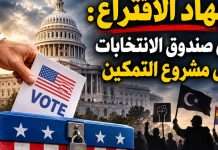
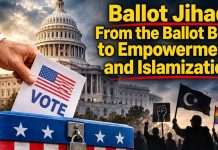
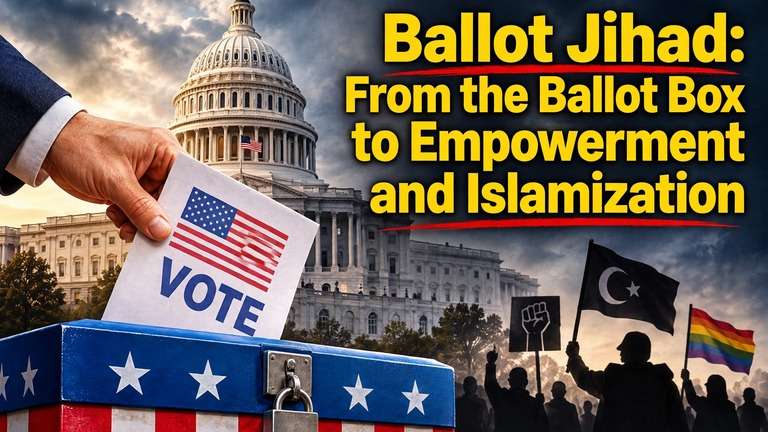
Ballot Jihad: How Political Islam Uses Elections in Europe and America as a Weapon to Infiltrate the West and Achieve Empowerment and Islamization
Elias Bejjani/November 04/2026
Introduction: America Votes, and Political Islam Seeks an Opportunity for Empowerment
The US elections held yesterday, Tuesday November 03, 2026, were not just a normal election or a traditional democratic transfer of power. The results, which led to the Democratic Party taking control of both houses of Congress after Republicans lost many seats, raise a very dangerous question about the future of the West, and about the ability of Western democracies to protect themselves from ideological movements that use the freedoms available to reach power and expand influence.
What deserves attention is not only the victory of Democrats and the defeat of Republicans, but the nature of the electoral alliances formed inside American society, and how different political forces used population, religious, and cultural blocs, including organized Muslim voting blocs, to reach decision-making centers. Americans and Westerners in general must understand that political Islam, both Sunni and Shia, especially Muslim Brotherhood currents, does not look at elections the way liberal democracies do. All these movements treat elections as a means to reach power, build institutions and influence, and achieve their ideological, political, and religious projects.
Ballot Jihad.
After armed jihad, coups, assassinations, and terrorism, the ballot box has become in the calculations of all jihadist Islamic movements a very important political and organizational weapon. The goal is not just to win a parliamentary or local seat, but to use the win to build power and influence that opponents will find hard to confront later.
US Election Results and Their Political Message
Yesterday’s results showed a big shift in the American balance of power, as Democrats (left, gay groups, political Islam) regained the majority in the House and Senate, and won in states considered Republican strongholds. One notable event was the win of Dr. Abdul Salam Al-Sayed for a Senate seat in Michigan, known for his ideological affiliation with the Muslim Brotherhood groups and his family, becoming the first Muslim elected to this chamber in US history. This event has political, demographic, and electoral importance, but by itself it does not mean political Islam has taken over American institutions, nor does it prove that all Muslim voters vote according to one organizational directive.
The problem we discuss is much deeper.
Organized voting blocs, whatever their identity, can become influential in close races, and turn into a bargaining force that imposes conditions on major parties. When ideological organizations like the Muslim Brotherhood invest in this fact, it becomes necessary to monitor their programs, connections, and political goals. American democracy allows a Muslim citizen and a non-Muslim citizen to vote, run for office, and reach the highest positions, and this is a constitutional right that must not be touched. But it does not give any Islamic or non-Islamic organization the right to use these freedoms to cancel the freedoms of others or to impose an ideological rule on them.
Ballot Jihad… The New Weapon of Political Islam
We must be clear about the plans, tricks, and taqiyya of political Islam, which does not always need a rifle, a suicide bombing, or an armed militia to achieve its goals. It can use elections, party alliances, associations, educational institutions, media, municipalities, and unions as multiple fronts for one political battle, and this is the essence of what we call ballot jihad. In democratic societies, political Islamic movements have wide space for freedom, organization, and expression, and can benefit from laws that protect religious and political pluralism. But the danger begins when these freedoms turn into tools to build a jihadist and religious authoritarian project that does not really believe in the right of others to exercise the same freedoms.
The electoral empowerment strategy of these jihadist and terrorist Islamic organizations is based on:
Mobilizing voters on the basis of religious, ideological, and organizational loyalty.
Using demographic weight in close electoral districts.
Pressuring major parties to get political concessions.
Building temporary electoral alliances with forces that differ ideologically.
Organizational control or wide influence over civil society institutions.
Placing their cadres in municipal councils, legislative institutions, and centers of influence.
Turning electoral gains into long-term political, legislative, and media influence.
Thus the ballot box becomes, in the calculations of these movements, a front of political jihad… It is a battle not necessarily fought with weapons and all kinds of terrorist operations, but with votes, organization, money, alliances, and exploiting legal and political loopholes. The question the West must ask is: Do these organizations accept democracy as a permanent principle, or do they accept it only when it is a path to power?
The Muslim Brotherhood and the Empowerment Project
It is impossible to understand a basic aspect of contemporary political Islam, both Sunni and Shia, without studying the concepts, doctrines, plans, and projects of the Muslim Brotherhood, founded by Hassan al-Banna in Egypt in 1928. The Brotherhood is not just a charity or traditional religious movement, but an ideological movement with a transnational political and organizational project, based on making Islam the reference for governance, society, and the state. Over decades, the group’s methods and branches evolved, some entered elections and parliaments, formed political alliances, and some reached power. But electoral participation does not automatically mean abandoning the jihadist ideological project or accepting all foundations of a civil state and liberal democracy. The concept of empowerment (tamkeen) in the literature of all jihadist Islamic currents refers to moving from the stage of building the organization and social base to the stage of expanding influence and reaching centers of power. Here lies the importance of monitoring what these movements announce in their electoral programs, what they say in their internal literature, and what they do when they hold power. Therefore the West should not be satisfied with hearing democratic slogans, but should ask about the real position on freedom of belief, women’s rights, rights of Christians and Jews, freedom of expression, independence of judiciary, and peaceful transfer of power.
Taqiyya, Gradualism, Abrogation… The Problem of Temporary Discourse
One of the issues to stop at when studying the political religious discourse of Muslim Brotherhood groups in all their organizations and branches is the issue of gradualism in action, the gap between public discourse and political practice, and how religious texts are used to serve ideological goals. These movements present themselves in Western societies as moderate, defending freedoms, pluralism, and minority rights, while in their other literature or positions they adopt different views about state, society, and source of legislation. We should not consider every moderate discourse as deception, or attribute taqiyya to every Muslim, but we have the right, indeed the duty, to ask about the extent to which public discourse matches the actual political program. Here the importance of studying the concepts of taqiyya, gradualism, and empowerment in their jurisprudential and organizational contexts appears, and not allowing them to be used to justify hiding political goals or evading accountability. As for dividing Quranic verses into peaceful verses in the phase of weakness and fighting verses in the phase of strength, it is a complex interpretive and jurisprudential subject, and it should not be reduced to one equation that applies to all Muslims. But what the West must understand is that religious and electoral slogans are not enough to judge any movement. The criterion is its real program and its behavior when it has power.
The Opportunistic Alliance Between the Left, Political Islam, and Gays
One of the paradoxes worthy of criticism and study in Western politics is the emergence of electoral and interest-based alliances between currents of the radical left and groups of political Islam and gay groups. This alliance is not based on unity of doctrine or values, but on intersection of immediate electoral and political interests. The left needs Muslim voters’ votes in some districts, political Islam needs doors to institutions where the left has influence, and alliances that help it expand its political presence… and gays need forces that support their demands… Here a stark paradox appears. Political Islamic groups adopt very conservative positions, reject homosexuality, and oppose basic aspects of individual freedoms defended by leftist groups. Yet, we find electoral and political intersections between the three parties when their interests meet against a common opponent. The left raises slogans of diversity and pluralism, while Islamic movements allied with it adopt religious and political views that do not accept pluralism in the liberal sense… The same opportunistic equation applies to the alliance of gays with those who stay silent or support their life and rights demands.. What kind of alliance is this? And what intellectual harmony is there between projects, aspirations, concepts, values, and lifestyles that are contradictory? It is an alliance of interests and votes, not an alliance of principles. And the danger is that some Western parties may discover too late that the votes they invested in do not necessarily adopt the social and cultural project they defend.
Example of Hamas and Gaza… What Does Political Islam Do After Winning?
The experience of Palestinian Hamas provides a model that must not be ignored when discussing political Islam’s relationship with elections. In January 2006, jihadist and terrorist Hamas won the majority of seats in the Palestinian Legislative Council, in elections in which Fatah and other political forces participated. But in June 2007, after bloody armed confrontations with Fatah, Hamas took control of Gaza by force, expelled the Palestinian Authority from it, and established a unilateral rule under which no new general elections were held. These facts are not just historical details, but raise a fundamental question about the difference between electoral victory and respect for democracy. Elections give the winner the right to govern within the constitution and law, and do not give him the right to abolish opposition or use weapons against opponents or monopolize power indefinitely. Here the difference appears between democracy as a fixed political value, and democracy as a tactical means to reach power.
Hitler and the Historical Lesson That Must Not Be Forgotten
European history itself provides a stark example of the danger of totalitarian movements reaching power through political and constitutional paths. Adolf Hitler reached the position of Chancellor on January 30, 1933 by presidential appointment, after the Nazi party became a large electoral force and benefited from alliances and political maneuvers.
After reaching power, he used state institutions and exceptional laws to dismantle democracy, ban opposition parties, and establish a dictatorial regime. Here the historical lesson is clear: Reaching power through elections or constitutional procedures alone does not prove that the movement is committed to democracy. Peoples have the right to know in advance whether whoever reaches power will preserve the rights of his opponents, or will use his authority to eliminate their political existence.
Role of Qatar, Turkey, and Iran… Money, Organization, and Weapons
Sunni and Shia political Islam based on the ideological concepts of terrorist Muslim Brotherhood groups cannot be studied apart from the regional and international influence network that supports it and invests in its expansion, and here three countries with different roles stand out:
Qatar: Has wide financial, media, and diplomatic tools, and has a history of relations with movements and figures linked to political Islam, in addition to influential international media influence.
Turkey: Under Recep Tayyip Erdogan, it became a political ally of a number of Islamic currents, and uses its political, media, and economic tools to enhance its regional influence.
Iran: Leads a Shiite political and military Islamic project under the authority of Wilayat al-Faqih, and uses its affiliated armed organizations in the region to expand its influence at the expense of state sovereignty.
Sunni and Shia political Islam are not one organization, but they intersect in many cases in putting ideological and organizational reference above the concept of an independent nation-state. The Sunni side includes multiple currents and organizations, including the Muslim Brotherhood, Hamas, al-Qaeda, and Boko Haram, with big differences in structure, goals, and means among them.
As for the Shia side, arms of the Iranian regime stand out, foremost Hezbollah in Lebanon, the Houthis in Yemen, and armed Iraqi factions linked to Tehran. These organizations are not all identical in their goals or methods, but their existence forces Western countries to deal with external financing, cross-border organizations, and political and military interventions seriously and transparently.
The Eastern Message to the West
We in the Middle East do not read these issues from books alone. We have lived long experiences with religious and political regimes, with armed organizations, and with countries where pluralism collapsed before the authority of doctrine and weapons. In Lebanon, we know well what it means for an armed organization to have the decision of war and peace outside state institutions, and for loyalty to an external reference to come before loyalty to the constitution and homeland, and we also know how religious slogans, resistance, and jihad can turn into tools to justify monopolizing power and decision. Therefore the warning we direct to the West is not a warning against Muslims, but against political Islam that wants to turn religion into political authority above constitution and law. A Muslim who lives in America or Canada or Europe, respects the constitution, believes in equality, and accepts the right of others to exercise their freedoms, is a citizen with full rights and duties. As for the organization that wants to exploit democracy to establish a system that does not recognize the rights of those who are not its followers, it is an opponent of democratic principles, regardless of the religion it uses as a cover for its project.
Conclusion: From Jihad by Sword to Jihad by Ballot
The recent American elections should be an occasion for a deeper reading of the future of Western democracy, and to notice that political conflict in modern societies does not always happen with weapons, but may happen through ballot boxes, party alliances, institutions, money, and media. Ballot jihad is the political expression of using elections as a means for empowerment, when the goal of democratic participation becomes reaching power, not respecting its rules, values, and principles, and political Islam, both Sunni and Shia, deserves serious critical study that does not flatter or compromise, and does not confuse it with Islam as a religion or Muslims as citizens. Hence the West must not deal naively with organizations that raise slogans of democracy in opposition, then reject pluralism when they reach power. Also the left must not ignore ideological and political contradictions with its electoral allies just to get extra votes… In the same context, gays should not ally with those who criminalize, prohibit, and betray their social lifestyle… And most importantly, Western institutions must not overlook any external financing or organizational connection or attempt to impose religious authority on civil society. The ballot box is not a weapon against democracy, but it can be turned into a political weapon against it when used by movements that do not accept peaceful transfer of power nor equality among citizens. Jihad by sword destroyed countries and societies, and ballot jihad may turn into another path to empowerment if accountability, transparency, and protection of institutions are absent. Beware that the ballot box turns into a Trojan horse through which enemies of pluralism and groups of terrorism and barbarism enter democratic institutions!
Democracy does not protect itself just by opening ballot boxes, but by protecting the constitution, law, freedoms, and the right of every citizen to live free, whatever his religion, origin, or belief. The West is not required to abandon its democracy, but is required to understand that everyone has the right to participate in elections, and no party has the right to use this participation to abolish democracy itself.
Finally, it is very important that the world, with all its countries and systems, understands the reality of the contradictions in the Muslim Brotherhood’s discourse:
In the phase of weakness in the West and in any country in the world (Dar al-Harb / House of War), the Muslim Brotherhood raises the Meccan verses – the verses of patience and peacefulness:
“O you who have believed, persevere and endure and remain stationed” [Al-Imran: 200]
“And be patient, and your patience is not but through Allah” [An-Nahl: 127]
“Indeed, Allah is with the patient” [Al-Baqarah: 153]
“And if they incline to peace, then incline to it and rely upon Allah” [Al-Anfal: 61]
“There shall be no compulsion in religion, the right path has become clear from the wrong” [Al-Baqarah: 256]
“For you is your religion, and for me is my religion” [Al-Kafirun: 6]
With these verses they address the West: We are moderate, democratic, we believe in coexistence.
And at the time of empowerment and strength (Dar al-Islam/House of Islam) in any country, the Muslim Brotherhood applies the Medinan verses – the verses of the sword and empowerment which abrogate what came before them:
“And when the sacred months have passed, then kill the polytheists wherever you find them and capture them and besiege them and sit in wait for them at every place of ambush” [At-Tawbah: 5]
“Fight those who do not believe in Allah nor in the Last Day” [At-Tawbah: 29]
“And fight them until there is no fitnah and the religion, all of it, is for Allah” [Al-Anfal: 39]
“And He brought down those who supported them among the People of the Scripture from their fortresses