The Feast of Saint Maroun For more than 1,600 years, Maronites in Lebanon and throughout the world have celebrated the annual commemoration of Saint Maroun on the ninth of February. Each year, over ten million Maronites honor the founder of their Christian Catholic Church—Maroun the priest, the hermit, the spiritual father, the leader, and the saint. On this sacred day, Maronites remember their long and often painful history since the fourth century, reflecting on both times of suffering and moments of triumph. They look back at the past, assess the present, and contemplate the future. Above all, they pray for peace, democracy, and freedom in Lebanon—their homeland—and across the world.
The Origins of Saint Maroun Who was Saint Maroun? How did he establish his spiritual movement? Where did he live, and who are the people who carry his name? According to the late Lebanese philosopher and historian Fouad Afram Al-Bustani, Saint Maroun was born and raised in the city of Kouroch. This city lies northeast of Antioch (present-day Turkey) and northwest of Hierapolis (Manbij), the capital of Euphrates Syria. Kouroch still exists today, located about 15 kilometers northwest of the city of Azaz and roughly 70 kilometers north of Aleppo in Syria.
The Hermit of Mount Semaan Historians Father Boutrous Daou and Fouad Afram Bustani recount that Maroun chose to live on Mount Semaan—formerly known as Mount Nabo, named after the pagan god Nabo. Geographically, the mountain lies between Antioch and Aleppo. At the time, it was completely abandoned and desolate. The ruins of an ancient pagan temple on the mountain attracted Maroun. After purifying the site, he used the structure only for celebrating Mass and offering the Holy Eucharist, while spending the rest of his life outdoors. He devoted himself entirely to prayer, fasting, and extreme asceticism, depriving his body of all comfort and exposing himself to sun, rain, hail, and snow. His holiness, faith, and miraculous healing powers soon became widely known. Thousands of believers sought him for guidance, healing, and spiritual counsel. Saint Maroun was also a learned and compelling preacher, unwavering in his belief in Christ and Christianity.
A Mystic and Spiritual Reformer Saint Maroun was a mystic who pioneered a unique ascetic and spiritual path that attracted followers from across the Antiochian Empire. As a zealous missionary, he sought not only to heal physical ailments but also to restore the souls of pagans and Christians alike. His reputation reached great heights. Around 405 AD, Saint John Chrysostom sent him a letter expressing deep admiration and asking for his prayers. Saint Maroun’s spirituality was profoundly monastic and holistic. He saw no separation between the physical and spiritual worlds, using the material world as a means to deepen his union with God. Through prayer and solitude, he transcended physical suffering and entered into an intimate, mystical relationship with the Creator. His spiritual magnetism drew hundreds of monks and priests who became his disciples and devoted followers.
The Spread of the Maronite Mission After Saint Maroun’s death, his disciples spread the Gospel throughout the Antiochian Empire—modern-day Syria, Lebanon, Turkey, Iraq, Jordan, and Israel. They built hundreds of churches, monasteries, and schools, becoming known for their faith, devotion, and perseverance. Saint Maroun died peacefully around the year 410 AD at the age of seventy, surrounded by his disciples. He wished to be buried beside his spiritual mentor, the monk Zabena, in the town of Kena near Kouroch. However, this wish was not fulfilled. Residents of a nearby town took his body, buried it there, and built a grand church over his grave, which became a major Christian shrine for centuries. Its ruins still stand today.
Persecution and the Rise of the Maronite Nation Following his death, Saint Maroun’s disciples built a major monastery near the Orontes River (Nahr Al-Assi) along the Syrian-Lebanese border. For centuries, this monastery stood as a beacon of faith, education, holiness, and martyrdom. In the early tenth century, during one of the most brutal periods of Christian persecution, the monastery was destroyed, and more than 300 Maronite priests were massacred. The surviving monks fled to the mountains of Lebanon. There, together with the Marada and the native Lebanese population, they laid the foundations of the Maronite nation, transforming Lebanon’s mountains into a stronghold of faith, endurance, and resistance.
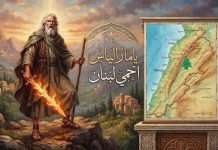
Saint Maroun and Lebanon The Maronite presence in Lebanon began early, particularly through Saint Maroun’s disciple Abraham of Cyrrhus, known as the Apostle of Lebanon. Recognizing the persistence of paganism in the region, Abraham worked to convert the population to Christianity by spreading Saint Maroun’s teachings. Saint Maroun is thus regarded as the father of the spiritual and monastic movement that became the Maronite Church. This movement profoundly influenced northern Syria, Lebanon, Cyprus, and eventually many countries worldwide where Maronites settled. Today, the largest Maronite community outside Lebanon is in Brazil, home to more than six million Lebanese descendants following major waves of emigration in the early twentieth century.
The Maronite Identity The renowned historian Fouad Afram Boustani (1904–1994) described the Maronite faith as one of intelligence, life-affirmation, unwavering Catholic belief, love for others, continuous struggle for righteousness, openness to all civilizations, and readiness for martyrdom. The Maronites played a central role in establishing the modern state of Lebanon, making it a refuge for persecuted minorities in the Middle East. They embraced and practiced pluralism and multiculturalism, helping create Lebanon’s unique national identity. Since the fourth century, the Maronites and Lebanon have been inseparable—each defining the other. Throughout history, the Maronite people transformed defeat into victory, sorrow into joy, and despair into hope. Through faith, sacrifice, and perseverance, they fulfilled the four pillars of nationhood: land, people, civilization, and political independence. They have always fought for their rights and never surrendered to despair.
Prayer to Saint Maron O Saint Maron, man of prayer, sacrifice, and freedom, intercede for us before God. Pray for Lebanon, wounded and occupied, that it may be healed from its pain and freed from injustice, corruption, and fear. O spiritual father of the Maronites, lead your people back to your faith, to the values of holiness, truth, courage, and fidelity, to love of Christ and devotion to Lebanon. Pray for peace in our troubled world, for all who suffer and are oppressed, that light may overcome darkness, truth overcome falsehood, and hope overcome despair. Through your intercession, O Saint Maron, protect Lebanon and its people, and strengthen our faith. Amen.