Christophe Boltanski/Lukman Slim Foundation: The Ghosts of Hangar 12….A highly important study from the 2023 archives, published by the Lokman Slim Foundation, details Hezbollah’s assassination of four witnesses in connection with the Beirut port explosion: Joseph Skaff, Mounir Abou Rjeily, Joe Bejjani, and Lokman Slim/دراسة مهمة للغاية من أرشيف 2023 نشرتها مؤسسة لقمان سليم تحكي تفاصيل اغتيال حزب الله لأربعة شهود على خلفية تفجيره مرفأ بيروت هم جوزيف سكاف، منير أبو رجيلي، جو بجاني، ولقمان سليم
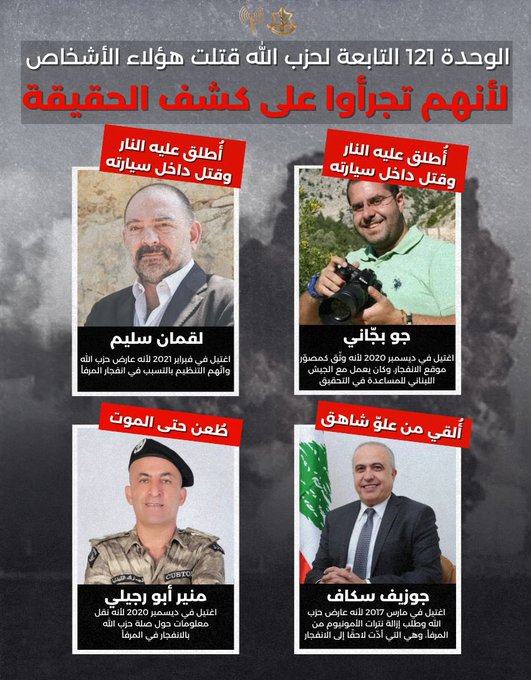
جيش الدفاع يكشف: هكذا قامت الوحدة 121 التابعة لحزب الله اللبناني باغتيال الشخصيات التي توعدت بكشف النقاب عن دور حزب الله الإرهابي في انفجار مرفأ بيروت افيخاي ادرعي/موقع أكس/02 كانون الأول/2025 كشف جيش الدفاع أن الوحدة 121 التابعة لحزب الله اللبناني قامت باغتيال أربع شخصيات لبنانية معروفة خشية من قيامها بكشف النقاب عن خلفية انفجار مرفأ بيروت في شهر أغسطس 2020 بسبب تخزين نترات الأمونيوم من قبل حزب الله، علمًا بأن المغتالين كانوا ضباط في قسم الجمارك وصحفيين أشاروا إلى ارتباط حزب الله بالانفجار. جوزيف سكاف، الذي كان يشغل منصب رئيس قسم الجمارك في مرفأ بيروت – تم إلقاؤه من مكان مرتفع حتى لقي حتفه من قبل عناصر الوحدة 121 في 2017 بعد ان طلب إخراج كميات نترات الأمونيوم التابعة لحزب الله من المرفأ، وهي نفس المادة التي أدت بعد ذلك إلى الانفجار. منير أبو رجيلي، الذي كان يشغل منصب رئيس وحدة منع التهريب في دائرة الجمارك – تم اغتياله طعنًا من قبل عناصر الوحدة في شهر ديسمبر 2020 على اثر معلومات أدلى بها حول ارتباط حزب الله بالانفجار في المرفأ. جو بجاني، مصور كان من أول الذين تمكنوا من توثيق مشهد الانفجار وتم توظيفه من قبل الجيش اللبناني للمساعدة في عملية التحقيق – تم اغتياله بالرصاص وهو بسيارته في شهر ديسمبر 2020 من قبل عناصر الوحدة 121، والتي سرقت هاتفه الخلوي قبل فرارها من مشهد الاغتيال. لقمان سليم، ناشط سياسي وصحفي كان يوجه انتقادات كثيرة إلى حزب الله – تم اغتياله هو الآخر بالرصاص وهو بسيارته في شهر فبراير 2021 من قبل عناصر الوحدة، وذلك بعد فترة وجيزة من قيامه باتهام حزب الله ونظام الأسد بالمسؤولية عن الانفجار. نفى حزب الله تورطه في هذه الاغتيالات الأربعة، ولم يكتمل التحقيق في أي منها. تضاف هذه الأحداث إلى اغتيال رفيق الحريري واغتيال إلياس الحصروني، اللذين كشفنا سابقًا ضلوع حزب الله فيهما، ناهيك عن قائمة طويلة لم نكشفها بعد.
Port Explosion: Israeli Army Claims Hezbollah Eliminated Four Key Witnesses This is Beirut/December 02/2025 The Israeli army accused on Tuesday a Hezbollah unit of assassinating four Lebanese figures who allegedly possessed information implicating the Shiite movement in the Beirut port explosion of August 2020, according to its Arabic-language spokesperson, Avichay Adraee, on X (formerly Twitter). According to the Israeli army, Hezbollah’s Unit 121 allegedly targeted customs officials and journalists who could have revealed that the ammonium nitrate stored at the port had been kept there on behalf of the group. Among those mentioned is Joseph Skaff, former head of Beirut port customs, who was reportedly killed in 2017 after requesting the removal of the substance. The Israeli army also cited Munir Abu Rajili, former head of the customs anti-smuggling division, who was stabbed to death in December 2020, as well as photographer Joe Bajani, who was shot dead in his car the same year after documenting the explosion and assisting the Lebanese army’s investigation. It further attributed to Unit 121 the February 2021 killing of intellectual and activist Lokman Slim, a prominent critic of Hezbollah, shortly after he publicly accused the group and the Syrian regime of responsibility for the blast.
أشباح الهنكار 12 في مرفأ بيروت كريستوف بولتانسكي/مؤسسة لقمان سليم/ 03 آب/أغسطس 2023 (ترجمة بحرية من الإنكليزية بواسطة الياس بجاني بالإستعانة بمواقع ترجمة ألكترونية)
The Ghosts of Hangar 12 Christophe Boltanski/Lukman Slim Foundation/August 03/2023 The Beirut Port Blast of Aug. 4, 2020 killed more than 200 people and injured thousands. To this day, it is still unclear who imported the ammonium nitrate to the port, and why. With the official investigation stalled, a series of suspicious assassinations has fostered doubts about the cause of the catastrophe.
Christophe Boltanski wades through the tangle of facts and lies to try and assemble the puzzle. For want of something better, the highway that spans the port of Beirut serves as a memorial to the families of the dead. Surrounded by crude drawings and angry slogans, photos of the victims of the fireball that devastated part of the city on Aug. 4, 2020 line the side of the bridge. This highway, perpetually jammed with traffic, is hardly a place for contemplation, but from its vantage point everything is in plain view: the heaps of torn metal, burned-out cars, boats on their side, twisted pulleys, the skeletal towers of the grain silo, and, where the dock should be, a huge crater awash with muddy water. In the distance one can even see the pier next to which the Rhosus sank, omen of the disaster to come.
A mosaic shattered into a thousand pieces. An enigma. This is what Beirut’s port looks like: a time-frozen field of ruins, the visual replica of a paralyzed justice system. The inquiry is stalled because of the diverse proceedings brought against Tarek Bitar, the judge in charge of the investigation. Three years further on, one of history’s largest non-nuclear explosions remains unexplained: 235 deaths, more than 6,500 injured, 77,000 apartments destroyed, and zero results. No trial to date, not even one accomplice behind bars. A new unpunished crime in a country that has seen so many others.
Journalists, lawyers, activists are trying to break down this wall of silence. They want to understand how a cargo of explosives could arrive in Beirut and then be left abandoned in a hangar for six long years, before detonating in a blinding shaft of light. To achieve their purpose, they must unravel an incredible tangle of false names, shell companies, fraud and lies. “It’s a lifetime worksite” comments Zena Wakim, a lawyer with the foundation Accountability Now, which works against impunity in Lebanon. “In this affair, things are never what they seem. It all requires investigations which are extremely complicated and dangerous.”
From the start, one man proposed a method for not getting lost in this tentacular case. “What we have here is a jigsaw puzzle,” explained Lokman Slim, during an interview on Arabic television. This Lebanese intellectual, publisher, archivist, translator and documentarist is remembered for his free-speaking, secular, rigorous, sometimes forceful style. His idea was to examine the total picture, and not the sum of different elements, because a single piece, examined on its own, signifies nothing. Once the sides of the puzzle have been assembled, the large volumes defined and certain details brought to light, a whole other picture appears. While the Lebanese authorities would only concede a series of omissions, Lokman Slim denounced a “war crime” committed by Russia, Syria and Hezbollah. Twenty days later he was found shot to death in his car.
His body lies at rest in his garden, in front of the family house in southern Beirut. To reach his grave, one must get through a roadblock, then a second, then a maze of narrow streets decked in yellow, the color of Hezbollah. On the walls of the gray, high-rise buildings there are faded portraits of “martyrs” in combat gear. In the midst of this chaos of concrete and warlike images, the Villa Slim is an oasis. The front door is open, as always. The son of an eminent Shiite lawyer, Lokman Slim lived among his own in the district of Haret Hreik, now the stronghold of a political-military movement that he relentlessly challenged.
Surrounded by her husband’s countless books and files, the German-Lebanese filmmaker Monika Borgmann is fighting to know the truth: “His interview caused a stir. He was just presenting facts in a very logical way. Naturally people told him: ‘You’re going too far.’ But he had given so many interviews on sensitive subjects.” Lokman’s sister, Rasha al-Ameer, who with her brother created the publishing house Dar al-Jadeed, has similar doubts: “He was obstinate. It was David against Goliath. I used to tell him: ‘They have rockets but what do you have?’” She sighs. “This interview was maybe the last straw, but they had plenty of other reasons to kill him.”
Slim’s is not an isolated case. Like the aftershocks that follow an earthquake, major crimes in Lebanon always give rise to others. In the aftermath of the explosion, several assassinations shocked the city. Homicides that were never solved, always perpetrated by professionals and followed by botched investigations, too quickly suspended for an alleged lack of leads and suspects.
At first glance, the victims have nothing in common, except that they are all linked to the port of Beirut. Why were they murdered? Was it because of information they had or the post that they occupied? Did they threaten to break the law of silence? Would their testimonies have helped reconstitute the pieces of the puzzle? Their friends and families have agreed to speak, some for the first time, most of them remaining anonymous and obviously scared. “Be diplomatic,” one of them whispered, “because our lives are at risk.” Before telling their story, it will be useful to examine another suspicious death, the death of a customs officer that occurred before the catastrophe.
In Beirut port, colonel Joseph Skaf headed the anti-illegal migration and money laundering division. On Feb. 21, 2014 he alerted his seniors to the “public security” risk posed by a vessel, the Rhosus, docked for the last three months, because it was carrying ammonium nitrate, “a highly dangerous and explosive material.” In a handwritten letter, he advised that it should be moved away from the pier to the breakwater and put under surveillance. “Before him, no-one had mentioned the presence of nitrate in the port,” said one of Lebanon’s most eminent investigative journalists, Riad al-Qobeissi of the Jadeed-TV channel. The customs officer suspected fraud. He found it strange to moor a cargo for such a long time at that location. That is why he asked for it to be moved away.
Who owned the Rhosus ? How did it get there? According to a first version based on the testimony of its captain, it was acquired by a Russian businessman, Igor Grechushkin, convicted of aggravated theft and without naval experience. The vessel left Batoumi, on the Black Sea, on Sept. 27, 2013 heading for the port of Beira in Mozambique, with a cargo of 2,750 tons of ammonium nitrate produced by the Georgian chemical plant Rustavi Azot, the end client being a private firm, the Fabrica de Explosivos de Moçambique. In heavy debt, the shipowner diverted the vessel to Beirut in order to load a second cargo and thus have the necessary funds for its passage through the Suez Canal. But the seismic survey machines that the Rhosus was to take on board were too heavy. During loading on Nov. 25, they damaged a hatch cover. The port authorities declared the vessel unfit for navigation and immobilized it, later ordering its seizure after complaints of unpaid claims. Greshushkin took this opportunity to disappear. This account, widely repeated, is full of lies.
After being transferred to airport customs operations, colonel Skaf let the matter rest. His letter was never answered. Stuck in a drawer somewhere, it never even reached some of those it was addressed to. If this officer had not been transferred somewhere else, could he have prevented the catastrophe? “We will refuse to let them unload this cargo,” he told his brother.
The catastrophe should never have happened. As in other countries, Lebanese law forbids materials for military use entering its territory without a special permit. Depending on its nitrogen content, ammonium nitrate has various uses: below a threshold of 33.5 percent, it is a widely used fertilizer. Above this, it is used to make explosives. With a content of 34.7 percent, the white powder packed into the hold of the Rhosus is used to make bombs.
On the first documents — the unified list and arrival statement — sent to customs and the port authority, this was not mentioned. The mails exchanged between the various departments did not define the nature of the merchandise. The authorities only seemed to be concerned by the unloading process because the vessel was at risk of sinking. On June 27, 2014 a summary judgment judge ordered the cargo to be stored in a “safe place.” He also had no idea what was in it. “In its request, the Ministry of Public Works and Transportation mentions a ‘dangerous substance’ which might pollute port waters. Why does it not mention ammonium nitrate?” asks Riad al-Qobeissi. At the time, the holder of this coveted, and very lucrative, portfolio was Ghazi Zeaiter, a leader of the Shia party Amal, Hezbollah’s ally.
The vessel’s contents were unloaded on the sly during the night of Oct. 22-23, 2014 and stacked in Hangar no. 12, reserved for dangerous materials, and then forgotten. Two years later Joseph Skaf, now aged 56, retired and ran for office in parliamentary election on an independent ticket. On March 4, 2017 he attended a campaign dinner. At 3 a.m. he had still not returned to his apartment in the north of Beirut. His wife failed to reach him by phone. She was worried. A friend went to look for him and found his Range Rover at the foot of his building, headlights on, the trunk open. He shouted “Joseph” and saw his body 1.8 meters away, stretched out, arms crossed, on the ramp going down to the underground carpark. His skull was crushed, his eye swollen, his hands and knees covered in bruises and a rib broken, as if he’d been in a fight. The autopsy found no internal cause that would explain his fall. No heart attack, no stroke, no alcohol in the blood. A medical report attributed his death to a cerebral hemorrhage, with no other details. The police called it an accident.
“They did not protect the scene of the crime and questioned no one. They wanted to close the case as quickly as possible,” said one of his close friends. A forensic medical expert appointed by the family came to a very different verdict. According to him, Skaf “was the victim of a brutal attack.” He was struck in the eye and below the rib cage before being pushed from a great height.
A customs officer will always have enemies, especially at Beirut port, nicknamed “the cave of Ali Baba and the 40 thieves.” This outgrowth in the heart of the city is a concentrate of the shortfalls in the Lebanese system. It’s the kingdom of fraud, bribery, the mafia, scandal after scandal. Forced to act after so many empty promises, in 2019 president Michel Aoun created an anti-corruption bureau in the heart of the port zone and entrusted it to State Security, one of the country’s four intelligence services.
“My mission was to gather information on every form of misappropriation. We started from scratch, with few resources or staff,” recalls its chief, captain Joseph Naddaf. He now works in a newly renovated building near the container terminal. His old offices, next to the silos, were destroyed. Civilian security agents armed with assault weapons ensure his protection. Aged 35, dressed in jeans and a polo shirt, he is the whistle-blower in this story. His warnings, instead of being heeded, tripped off a devastating chain reaction.
Towards the end of 2019, a “source” informed him of the presence of ammonium nitrate in Hangar 12. His investigation didn’t get far. “I didn’t know what it was. I had to ask experts, and it was the beginning of Covid.” When he visited the hangar, he was surprised to see there was no watchman there. “One of the rear doors of the warehouse had been forced open. Right next to it, there was a hole in the wall fifty centimeters in diameter. I could see bags piled in great disorder. Anyone could have taken them.” Staying outside, he just took photographs of the ripped, half-empty bags. “I was not authorized to enter. Only customs and the port authority had access. My role was just to make a report.” He wrote five. In the report delivered to the prosecutor’s office on June 1 2020, he reiterated the facts, with the warning: “Ammonium nitrate, in case of fire, would cause a huge explosion with disastrous consequences for Beirut’s port. We fear that this material could be stolen and used to make explosives.”
His report started making the rounds and threatened to be leaked in the media. On July 20, State Security sent a summary of it to President Aoun and Prime Minister Hassan Diab. A risk of theft and explosion? Once the matter had been referred, general prosecutor Ghassan Oueidat could have demanded that the bags be transferred to a secure location, or even that they should be counted to make sure none was missing. He simply asked for repairs to be made. On August 4, around 4 pm, three workmen from an outside company soldered the damaged door without knowing what was behind it. The port employee who should have supervised the work was not there.
After their departure, at 5:54, a witness posted a video on Twitter showing thick, black smoke clouds billowing over the hangar. The fire service arrived on site four minutes later. A first explosion shook the air at approximately 6:07, followed thirteen seconds later by an even more powerful one.
The next day, while stunned residents combed the ruins, the famous letter from Joseph Skaf reappeared online. His friends and family were stupefied to discover its existence. “He had never spoken about it to us, but it was definitely his handwriting,” said one of them. They didn’t know who had published his message from the grave, nor why it had been divulged at this precise time. It added more fire to their doubts. One of his sons, Michel, until then silent, tweeted on Aug. 8: “A crime was committed in March 2017. My father did not slip or fall. He was brutally attacked and assassinated in front of his home.”
Another case rekindled their suspicions. Once again it concerned a customs official, an ex-colonel. Having retired early, Mounir Abou Rjeily was building himself a second residence in Qartaba, a mountain village above Byblos. On Dec. 1, 2020 he went up there to see how the work was progressing. Because of a thick mist, he decided to sleep on site. In the morning, his cell phone was not answering. Worried out of her mind, his wife, Maguy, drove there and found him in pajamas on his bed, lying in a pool of blood. His teeth had been ripped out, his skull fractured. “There had to be at least three assailants,” said Simon Karam, the family’s lawyer. One of them beat him to death with a club, while the others held his shoulders. No prints, no signs of a break-in, no signal from an unknown phone in the vicinity. That specific day the neighbor was absent. It was a professional job. The judge opted for a presumed burglary that went wrong. After turning the villa upside down, the attackers left with a flat screen. Lawyer Karam denounced a decoy: “They didn’t touch the safe containing money and jewelry.” So what was the motive? “Our police force is very efficient,” he said. “In the case of organized crime, they quickly arrest the guilty. If it’s political, they never find them.”
When Maguy found her husband’s lifeless body, her first call was to the widow of Joseph Skaf: “They have killed Mounir, like Joseph!” she cried. The two men were friends. They both worked at the port. Shocked by the brutal death of his colleague, Mounir Abou Rjeily went into retirement five months later. Aged only 50. Did he know Joseph’s letter existed? “Of course,” said a friend. He brought his fingers together, pretended to write, staring in front of him, as if making imaginary signs in the air. “They wrote it together,” he murmured. A cycle of violence began that recalled the wave of killings perpetrated in 2005 after the assassination of former Prime Minister Rafik Hariri. The victims were personalities on the political or media scene. This time it was about ordinary people.
On Dec. 21, 2020 at 7 a.m. precisely, Joe Bejjani leaves his house. Every morning the same ritual: he turns on the heating in his GMC and waits for it to warm up to fetch his two daughters, then he drops them off at the kindergarten and drives to his office. He is 36 and works for the telecoms company Alfa. Built on the mountainside on the fringe of the Kahaleh township, his house overlooks Beirut. As is often the case in Lebanon, it is equipped with a video surveillance system. Just after the crime, the police viewed the images on site. Someone recorded the sequence with a mobile and posted it on Facebook. We see Joe get into his car. Ten seconds later, a man in a black woolen cap runs to catch up with the car, holding a pistol with a silencer. He opens the car door and fires four shots. An accomplice wearing a motorcycle helmet comes behind him carrying a sort of toolbox. He dives into the car, searches the body, snatches the victim’s mobile and slams the door. The two killers take off down rugged terrain, usually covered by scrub, which has since conveniently burned on two occasions. A motorcycle is waiting for them fifty meters below.
They barely take the trouble to disguise themselves. The first man is wearing an anti-Covid mask over his mouth, the second a helmet without a visor. Yet they know they are operating in the most scrutinized zone in the country. When they get down from the village, they go past the presidential palace, the ministry of defense, military barracks. “The police know their faces, their itinerary yet couldn’t identify them or find any details that would explain things. How is this possible?” asks Youssef Lahoud, the Bejjanis’ lawyer. The cameras lose all trace at the edge of the southern suburb.
“Who is Joe?” Amal, his mother, fights back her tears as she repeats the question, as if sharing it. Why take up against her son? He had no enemies. He was not in politics. One thing makes him stand out: “Since he was a boy, he loved everything to do with the army.” He spent his spare time photographing soldiers and tanks. He was on good terms with the Lebanese army who issued him a press card. In exchange, he gave them prints free of charge. Did he see something he shouldn’t have? On Aug. 14, 2020 he posted an image on his Twitter account that was widely shared: “In the background you can see the grain silos and Hangar 12 where the explosion occurred,” he wrote.
“When he posted that photo it got a lot of attention,” remembers Bejjani’s wife Nayla. “He took it in 2017, during a delivery of American tanks to the Lebanese army.” Were there other photos in the archive? “He often went to the port during military events. When he was in a zone that was closed to the public, he often took the opportunity to photograph other things.” That is all she knows. The police took away his cameras, computers, his USB key and the surveillance cameras. “They gave them back to us two weeks later. They were all empty.”
After a year of fruitless inquiry, Nayla Bejjani broke her silence and started giving interviews. “I was accusing everyone.”
The minister of the interior summoned her: “Take care,” he warned her. “Your daughters have already lost their father. I can’t protect you.” She now lives in France with her children and has refugee status. After the explosion, she recalls her husband’s fury. “He was very angry. He would say to me: ‘Lebanon is finished. We have to leave’.” On August 18 he posted a quotation from George Orwell: “The further a society drifts from the truth, the more it will hate those who speak it.” A bit later, he announced he was no longer going to work with the army. Several countries, including France and the United States, were at the time conducting investigations on site. “He wanted to help them.” How? Did he even do it? She does not know.
Will Judge Bitar manage to solve the mystery of what happened at the port? He has just a computer and two clerks at his disposal to unravel one of the most complex affairs in the country’s history. Those who stand to lose from his investigation are waging a full-blown war against him. He is the target of hate campaigns and there have been more than 40 demands that he recuse himself. Each time he resumes his investigation, yet another appeal stops it dead. If he looks to his peers for support, they find procedural obstacles springing up in their way. If he issues an arrest warrant, the police refuse to execute it. Having indicted the attorney general, Ghassan Oueidat, Oueidat sued him in turn for “abuse of power” and in the process, ordered the release of the 17 people still being held in prison.
“It’s maddening!” complains Paul Naggear. He and his wife Tracy have just attended a demonstration outside the courthouse as they do every month, alongside the parents of other victims. “There were around 30 of us. Why so few? People have given up hope.” They live at the top of a glass-fronted building opposite the silos. They lost their three-year-old daughter, Alexandra, on August 4 when the plate glass window in their lounge shattered. They didn’t expect much from the inquiry. “We knew it wouldn’t go anywhere.” They are calling for an inquiry led by the United Nations Human Rights Council. “What we want is to establish the facts.” So many of their questions have gone unanswered. Like many of Beirut’s inhabitants, Tracy is convinced she heard a plane before their world was turned upside down. She suspects a missile strike. “That’s the Israeli hypothesis,” says Paul.
French experts have discounted this line of inquiry. On Aug. 6, 2020 15 police forensics officers were dispatched to Beirut in connection with a manslaughter investigation opened in Paris (there were three French nationals among the deceased). They spent a week taking samples in and around the crater. Their report states that they were “working on the basis that a fire broke out at about 5.30 p.m. in the northern part of warehouse 12.” They tend to think it was an accident, but do not rule out criminal conduct. “We cannot make any assumptions about how the fire started.” They cite welding, an electrical fault, a cigarette butt or a malicious act (splashing flammable fluids around or setting fire to rubbish) as possible triggers. By contrast, “the fact that the explosions were preceded by a fire means that a missile or explosive device can be ruled out as the cause of the detonation: either would have resulted in an immediate explosion rather than a fire.” The FBI also sent specialists from the US. They concluded that just 550 tonnes of ammonium nitrate exploded on August 4. So what happened to the other 2,200 tons? It is possible that they burned up. French divers recovered ammonium nitrate blocks from the depths of the harbor. “When you have a deflagration rather than a detonation, the burning material disintegrates more quickly than it explodes. Particles are widely dispersed,” explains Brian Castner, an explosives expert with Amnesty International. Another possibility is that it was stolen. Part of the cargo could have been misappropriated either before or after it arrived in hangar no. 12.
“There are several things that lead me to think that some of it was missing,” says journalist Riad al-Qobeissi. We were told that the goods were unloaded in one night. I did the calculation and that’s impossible! It would have taken at least 48 hours to unload the ship. And you can’t store 2,750 one-ton sacks on this dockside, it’s just not wide enough.”
One of Lebanon’s neighbors used to make ample use of ammonium nitrate but is unable to import it as a result of international sanctions. From 2013 onwards, Syria has had a new weapon at its disposal: the barrel bomb, a rudimentary device developed by the Scientific Studies and Research Center, a Syrian regime ‘laboratory of horrors,’ and made from diesel, scrap metal and a few scoops of ammonium nitrate. Barrel bombs were used the following year, dropped from helicopters to wipe out rebel towns and cities.
While there is no hard proof of Syria’s involvement, there is a body of circumstantial evidence. In August 2020, the OCCRP (Organized Crime and Corruption Reporting Project), a consortium of journalists, revealed that the Rhosus belonged to Cypriot arms dealer Charalambos Manoli and not Grechushkin — he was simply the carrier and his contract had just expired when the ship was diverted to Beirut. At the time of the sailing, Manoli owed $1 million, pledged against his ship, to the Federal Bank of the Middle East (FBME), which was subject to US Treasury sanctions in 2014 for money laundering on behalf of Hezbollah and the Scientific Research and Studies Centre in Damascus.
Was the Rhosus simply bound for Southern Africa? Given the state it was in, it is unlikely that this floating dump would have been permitted to cross the Suez canal, where strict safety regulations apply. According to Megaphone, a Lebanese online information site, when Grechushkin’s lease expired, the ship could not cross the Mediterranean. As a result, on Nov. 1, 2012 it turned up in Tartous, a Syrian port that is home to a Russian naval base. “It sailed out, empty, five hours later, says Megaphone journalist Jonathan Dagher. What was it carrying? We don’t know.”
The Mozambicans never purchased the ammonium nitrate offloaded in Beirut. The buyer turned out to be a trading company, Savaro, an empty shell company with no assets and a straw (wo)man manager. “When we saw that this company was listed with Companies House in London, we referred the matter to the English courts,” says Nasri Diab, one of the lawyers for the port victims. On Feb. 1 the High Court in London found Savaro liable for damages over the explosion. The plaintiffs are still trying to identify its real owners. In another coincidence, Savaro shares its address at 10 Great Russell Street with engineering companies Hesco and IK Petroleum Industrial; all three companies have been at this location since the same date, June 25, 2011. Hesco and IK Petroleum Industrial belong to Georges Haswani and Imad Khoury respectively, businessmen with dual Syrian-Russian nationality. Both are subject to US sanctions for providing support to Bashar al-Assad’s war machine.
Lokman Slim was one of the first to point a finger at the Syrian regime and its Lebanese ally. On the evening of the blast, he jumped on a motorbike and rushed down to the harbor. He wanted to see, understand and report on what was going on. In the weeks that followed, he conducted an investigation, as he always did. He kept records of the country’s crimes for decades, to try and prevent people from forgetting. During these troubled times, Monika suggested they leave for Germany. He refused. “He wanted to stay here,” she says. “He thought there was a political opportunity to be seized.” He knew he was in danger. In 2019, Hezbollah activists plastered their home with death threats.
On Jan. 15, 2021 during an interview with Saudi’s al-Hadath television, he went even further in his accusations. On Jan. 31 the attacks began on the web. The same messages were posted over and over, calling him an agent in the pay of Israel. “The number of fake profiles and retweets was indicative of a highly orchestrated campaign,” says Nasri Messarra, a social media sociologist. On Feb. 3, Slim went for dinner at a friend’s house in Niha, in southern Lebanon. He was captured on a number of security cameras, which showed five cars tailing him. He was abducted that evening on the outskirts of the village and found at dawn, riddled with bullets, 40km away.
As with the other cases, there were no efforts to protect the crime scene. Onlookers mingled with police officers. Nobody wore gloves. And the investigation ground to a halt. “They only asked me personal questions — whether Lokman had had any clashes at work, if he was homosexual or suicidal — and not one about the threats he’d received,” says Borgmann. When his death was announced, Jawad Nasrallah, the son of the leader of Hezbollah, published a tweet that was promptly deleted: “The loss of some is in reality an unexpected gain and kindness to others.” In an open letter written in December 2019 following the attack on his home, Lokman Slim had held the leaders of the two Shi’ite factions, Hassan Nasrallah and Nabi Berri, “fully responsible” for whatever might happen to him.
أشباح الهنكار 12 في مرفأ بيروت كريستوف بولتانسكي/مؤسسة لقمان سليم/ 03 آب/أغسطس 2023 (ترجمة بحرية من الإنكليزية بواسطة الياس بجاني بالإستعانة بمواقع ترجمة ألكترونية) أودى انفجار مرفأ بيروت في 4 آب/أغسطس 2020 بحياة أكثر من 200 شخص وجرح الآلاف. حتى يومنا هذا، لا يزال من غير الواضح من استورد نترات الأمونيوم إلى المرفأ ولماذا. ومع تعثر التحقيق الرسمي، أثارت سلسلة من الاغتيالات المشبوهة الشكوك حول سبب الكارثة. يتغلغل كريستوف بولتانسكي في تشابك الحقائق والأكاذيب في محاولة لتجميع خيوط اللغز.
ذاكرة الطريق السريع لعدم وجود ما هو أفضل، يخدم الطريق السريع الذي يمتد فوق مرفأ بيروت كنصب تذكاري لعائلات القتلى. تنتشر على جانب الجسر صور ضحايا كرة النار التي دمرت جزءًا من المدينة في 4 آب/أغسطس 2020، محاطة برسومات فجة وشعارات غاضبة. هذا الطريق السريع، المزدحم دائمًا بالمرور، ليس مكانًا للتأمل، ولكن من موقعه يظهر كل شيء بوضوح: أكوام المعدن الممزق، السيارات المحترقة، القوارب المائلة على جانبها، البكرات الملتوية، الأبراج الهيكلية لصوامع القمح، وحيث يجب أن يكون الرصيف، حفرة ضخمة تغمرها المياه الموحلة. يمكن للمرء أن يرى في الأفق الرصيف الذي غرقت بجواره سفينة “روسوس” (Rhosus)، نذير الكارثة القادمة.
عدالة مشلولة فسيفساء تحطمت إلى ألف قطعة. لغز. هذا ما يبدو عليه مرفأ بيروت: حقل من الأنقاض تجمّد فيه الزمن، نسخة بصرية لنظام عدالة مشلول. لقد تعثر التحقيق بسبب الإجراءات المتنوعة المرفوعة ضد طارق بيطار، القاضي المسؤول عن التحقيق. بعد ثلاث سنوات، لا يزال أحد أكبر الانفجارات غير النووية في التاريخ دون تفسير: 235 قتيلًا، وأكثر من 6,500 جريح، و77,000 شقة مدمرة، وصفر نتائج. لا محاكمة حتى الآن، ولا حتى شريك واحد خلف القضبان. جريمة جديدة غير معاقب عليها في بلد شهد الكثير غيرها.
يحاول صحفيون ومحامون وناشطون اختراق جدار الصمت هذا. يريدون أن يفهموا كيف يمكن لشحنة من المتفجرات أن تصل إلى بيروت ثم تُترك مهجورة في هنجر لمدة ست سنوات طويلة، قبل أن تنفجر في شعاع ضوء أعمى. لتحقيق هدفهم، يجب عليهم فك تشابك لا يصدق من الأسماء المستعارة، والشركات الوهمية، والاحتيال، والأكاذيب. تعلق زينة واكيم، المحامية في مؤسسة المساءلة الآن (Accountability Now) التي تعمل ضد الإفلات من العقاب في لبنان، قائلة: “إنه مشروع يستغرق العمر. في هذه القضية، الأمور ليست كما تبدو أبدًا. كل هذا يتطلب تحقيقات معقدة وخطيرة للغاية”.
اللغز الذي قتله منذ البداية، اقترح رجل منهجية لعدم الضياع في هذه القضية المتشعبة. “ما لدينا هنا هو أحجية الصور المقطوعة (jigsaw puzzle)”، أوضح لقمان سليم، خلال مقابلة على التلفزيون العربي. يُذكر هذا المثقف والناشر والأرشيفي والمترجم والوثائقي اللبناني بأسلوبه الجريء والعلماني والدقيق والقوي أحيانًا. كانت فكرته هي فحص الصورة الكلية، وليس مجموع العناصر المختلفة، لأن قطعة واحدة، إذا فُحصت بمفردها، لا تعني شيئًا. بمجرد تجميع جوانب اللغز، وتحديد الأحجام الكبيرة، وتسليط الضوء على تفاصيل معينة، تظهر صورة مختلفة تمامًا. وبينما لم تعترف السلطات اللبنانية إلا بسلسلة من الإغفالات، ندد لقمان سليم بـ “جريمة حرب” ارتكبتها روسيا وسوريا وحزب الله. بعد عشرين يومًا، عُثر عليه مقتولًا بالرصاص في سيارته.
يرقد جثمانه في حديقته، أمام منزل العائلة في جنوب بيروت. للوصول إلى قبره، يجب على المرء أن يمر عبر حاجز طريق، ثم حاجز ثانٍ، ثم متاهة من الشوارع الضيقة المزينة باللون الأصفر، لون حزب الله. على جدران المباني الشاهقة الرمادية، هناك صور باهتة لـ “شهداء” في زي قتالي. وسط هذه الفوضى من الخرسانة والصور الحربية، تبدو فيلا سليم واحة. الباب الأمامي مفتوح، كما هو الحال دائمًا. عاش لقمان سليم، نجل محامٍ شيعي بارز، بين أهله في حي حارة حريك، الذي أصبح الآن معقلًا لحركة سياسية-عسكرية تحدّاها بلا هوادة.
تحارب المخرجة الألمانية-اللبنانية مونيكا بورغمان، المحاطة بالكتب والملفات التي لا حصر لها لزوجها، لمعرفة الحقيقة: “مقابلته أثارت ضجة. كان يقدم الحقائق بطريقة منطقية للغاية. بالطبع قال له الناس: ‘أنت تذهب بعيدًا جدًا’. لكنه أجرى العديد من المقابلات حول مواضيع حساسة”. لدى شقيقة لقمان، رشا الأمير، التي أنشأت مع شقيقها دار النشر “دار الجديد”، شكوك مماثلة: “كان عنيدًا. كان داوود ضد جالوت. كنت أقول له: ‘لديهم صواريخ ولكن ما لديك أنت؟'”. تتنهد. “ربما كانت هذه المقابلة هي القشة الأخيرة، لكن كان لديهم الكثير من الأسباب الأخرى لقتله”.
اغتيالات بعد الانفجار قضية سليم ليست حالة معزولة. مثل الهزات الارتدادية التي تلي الزلزال، غالبًا ما تؤدي الجرائم الكبرى في لبنان إلى جرائم أخرى. في أعقاب الانفجار، صدمت عدة اغتيالات المدينة. جرائم قتل لم تُحل أبدًا، ارتكبها دائمًا محترفون وتلتها تحقيقات فاشلة، عُلّقت بسرعة كبيرة لـ “نقص مزعوم في الخيوط والمشتبه بهم”.
للوهلة الأولى، لا يوجد قاسم مشترك بين الضحايا، باستثناء أنهم جميعًا مرتبطون بمرفأ بيروت. لماذا قُتلوا؟ هل كان بسبب معلومات لديهم أو المنصب الذي شغلوا؟ هل هددوا بكسر قانون الصمت؟ هل كانت شهاداتهم ستساعد في إعادة تجميع قطع اللغز؟ وافق أصدقاؤهم وعائلاتهم على التحدث، بعضهم للمرة الأولى، وغالبية منهم يفضلون عدم الكشف عن هويتهم ومن الواضح أنهم خائفون. همس أحدهم: “كن دبلوماسيًا، لأن حياتنا في خطر”. قبل سرد قصتهم، سيكون من المفيد فحص وفاة مشبوهة أخرى، وفاة ضابط جمارك حدثت قبل الكارثة.
جوزيف سكاف، ضابط الجمارك اليقظ في مرفأ بيروت، ترأس العقيد جوزيف سكاف قسم مكافحة الهجرة غير الشرعية وغسيل الأموال. في 21 شباط/فبراير 2014، نبه رؤسائه إلى خطر “الأمن العام” الذي تشكله سفينة، “روسوس”، راسية لمدة ثلاثة أشهر، لأنها كانت تحمل نترات الأمونيوم، “مادة شديدة الخطورة وقابلة للانفجار”. في رسالة مكتوبة بخط اليد، نصح بنقلها بعيدًا عن الرصيف إلى كاسر الأمواج ووضعها تحت المراقبة. قال أحد أبرز الصحفيين الاستقصائيين في لبنان، رياض قبيسي من قناة الجديد التلفزيونية: “قبله، لم يذكر أحد وجود النترات في المرفأ”. اشتبه ضابط الجمارك في وجود احتيال. وجد أنه من الغريب رسو بضاعة لفترة طويلة في ذلك الموقع. ولهذا السبب طلب نقلها بعيدًا.
من كان يملك “روسوس”؟ كيف وصلت إلى هناك؟ وفقًا لنسخة أولى تستند إلى شهادة قبطانها، فقد استحوذ عليها رجل أعمال روسي، إيغور غريشوشكين، المدان بالسرقة المشددة وبدون خبرة بحرية. غادرت السفينة باتومي، على البحر الأسود، في 27 أيلول/سبتمبر 2013 متجهة إلى مرفأ بييرا في موزمبيق، حاملة شحنة من 2,750 طنًا من نترات الأمونيوم أنتجتها منشأة روستافي آزوت الكيميائية الجورجية، وكان العميل النهائي شركة خاصة، فابريكا دي إكسبلوزيفوس دي موزامبيق (Fabrica de Explosivos de Moçambique). بسبب الديون الكبيرة، حوّل مالك السفينة مسارها إلى بيروت لتحميل شحنة ثانية وبالتالي توفير الأموال اللازمة لعبورها قناة السويس. لكن آلات المسح الزلزالي التي كان من المقرر أن تحملها “روسوس” كانت ثقيلة للغاية. خلال التحميل في 25 تشرين الثاني/نوفمبر، ألحقت أضرارًا بغطاء فتحة. أعلنت سلطات المرفأ أن السفينة غير صالحة للملاحة وقيدتها، ثم أمرت لاحقًا بمصادرتها بعد شكاوى عدم دفع المطالبات. انتهز غريشوشكين هذه الفرصة ليختفي. هذه الرواية، التي تكررت على نطاق واسع، مليئة بالأكاذيب. بعد نقله إلى عمليات جمارك المطار، ترك العقيد سكاف الأمر. لم يتم الرد على رسالته أبدًا. بقيت عالقة في درج ما، ولم تصل حتى إلى بعض أولئك الذين كانت موجهة إليهم. لو لم يُنقل هذا الضابط إلى مكان آخر، فهل كان بإمكانه منع الكارثة؟ قال لشقيقه: “سنرفض تفريغ هذه الشحنة”.
مخالفة القانون والتهريب ما كان ينبغي أن تحدث الكارثة أبدًا. كما هو الحال في بلدان أخرى، يحظر القانون اللبناني دخول المواد ذات الاستخدام العسكري إلى أراضيه دون تصريح خاص. اعتمادًا على محتوى النيتروجين، فإن لنترات الأمونيوم استخدامات مختلفة: أقل من عتبة 33.5 في المائة، هي سماد يستخدم على نطاق واسع. فوق هذا، تُستخدم لصنع المتفجرات. مع محتوى 34.7 في المائة، يُستخدم المسحوق الأبيض المعبأ في عنبر “روسوس” لصنع القنابل.
في الوثائق الأولى – القائمة الموحدة وبيان الوصول – المرسلة إلى الجمارك وسلطة المرفأ، لم يُذكر ذلك. لم تحدد المراسلات المتبادلة بين مختلف الأقسام طبيعة البضاعة. بدت السلطات مهتمة فقط بعملية التفريغ لأن السفينة كانت معرضة لخطر الغرق. في 27 حزيران/يونيو 2014، أمر قاضي الأمور المستعجلة بتخزين الشحنة في “مكان آمن”. لم يكن لديه أيضًا أي فكرة عما كان بداخلها. يتساءل رياض قبيسي: “في طلبها، تذكر وزارة الأشغال العامة والنقل ‘مادة خطرة’ قد تلوث مياه المرفأ. لماذا لا تذكر نترات الأمونيوم؟”. في ذلك الوقت، كان حامل هذه الحقيبة المرموقة والمربحة للغاية هو غازي زعيتر، وهو قيادي في حزب أمل الشيعي، حليف حزب الله.
تم تفريغ محتويات السفينة سرًا خلال ليلة 22-23 تشرين الأول/أكتوبر 2014 وتكديسها في الهنجر رقم 12، المخصص للمواد الخطرة، ثم نُسيت. وفاة غامضة بعد عامين، ترشح جوزيف سكاف، الذي بلغ من العمر 56 عامًا آنذاك، تقاعد وخاض الانتخابات البرلمانية على قائمة مستقلة. في 4 آذار/مارس 2017، حضر عشاء حملة. في الساعة 3 صباحًا، لم يكن قد عاد بعد إلى شقته في شمال بيروت. فشلت زوجته في الوصول إليه عبر الهاتف. كانت قلقة. ذهب صديق للبحث عنه ووجد سيارته الـ “رانج روفر” عند سفح مبناه، مصابيحها الأمامية مضاءة، والصندوق الخلفي مفتوح. صرخ “جوزيف” ورأى جثته على بعد 1.8 متر، ممددة، ذراعاه متصالبتان، على المنحدر المؤدي إلى موقف السيارات تحت الأرض. كانت جمجمته مهشمة، وعينه متورمة، ويديه وركبتيه مغطاة بالكدمات وضلع مكسور، كما لو كان في شجار. لم يجد التشريح سببًا داخليًا يفسر سقوطه. لا نوبة قلبية، لا سكتة دماغية، ولا كحول في الدم. عزا تقرير طبي وفاته إلى نزيف دماغي، دون تفاصيل أخرى. أطلقت الشرطة على ذلك “حادث”.
قال أحد أصدقائه المقربين: “لم يحموا مسرح الجريمة ولم يستجوبوا أحدًا. أرادوا إغلاق القضية بأسرع ما يمكن”. توصل خبير طبي شرعي عينته العائلة إلى حكم مختلف تمامًا. وفقًا له، كان سكاف “ضحية اعتداء وحشي”. تعرض لضربة في العين وتحت القفص الصدري قبل أن يُدفع من ارتفاع كبير.
الصافرة التي أطلقت الانفجار سيكون لضابط الجمارك دائمًا أعداء، خاصة في مرفأ بيروت، الملقب بـ “كهف علي بابا والأربعين حرامي”. هذا الامتداد في قلب المدينة هو تركيز لأوجه القصور في النظام اللبناني. إنها مملكة الاحتيال والرشوة والمافيا، وفضيحة تلو الأخرى. أُجبر الرئيس ميشال عون على التصرف بعد الكثير من الوعود الفارغة، فأنشأ في عام 2019 مكتبًا لمكافحة الفساد في قلب منطقة المرفأ وأسند إدارته إلى أمن الدولة، إحدى أجهزة المخابرات الأربعة في البلاد. يتذكر رئيسه، النقيب جوزيف نداف: “كانت مهمتي جمع معلومات عن كل شكل من أشكال الاختلاس. بدأنا من الصفر، بموارد وموظفين قليلين”. يعمل الآن في مبنى تم تجديده حديثًا بالقرب من محطة الحاويات. دُمرت مكاتبه القديمة، المجاورة للصوامع. يتولى عناصر أمن مدنيون مسلحون بأسلحة رشاشة حمايته. يبلغ من العمر 35 عامًا، ويرتدي الجينز وقميص بولو، وهو المُبلِغ في هذه القصة. تحذيراته، بدلاً من أن تُؤخذ على محمل الجد، أطلقت رد فعل متسلسل مدمر.
في أواخر عام 2019، أبلغه “مصدر” بوجود نترات الأمونيوم في الهنجر 12. لم يصل تحقيقه بعيدًا. “لم أكن أعرف ما هو. اضطررت إلى سؤال خبراء، وكانت بداية كوفيد”. عندما زار الهنجر، تفاجأ برؤية عدم وجود حارس هناك. “كان أحد الأبواب الخلفية للمستودع قد فُتح بالقوة. وبجواره مباشرة، كانت هناك حفرة في الحائط بقطر خمسين سنتيمترًا. كان بإمكاني رؤية أكياس مكدسة في فوضى كبيرة. كان يمكن لأي شخص أن يأخذها”. بالبقاء في الخارج، التقط صورًا فقط للأكياس الممزقة ونصف الفارغة. “لم أكن مخولًا بالدخول. فقط الجمارك وسلطة المرفأ كان لديهما حق الوصول. كان دوري مجرد إعداد تقرير”. كتب خمسة تقارير. في التقرير الذي سُلم إلى مكتب المدعي العام في 1 حزيران/يونيو 2020، كرر الحقائق، مع التحذير: “نترات الأمونيوم، في حال نشوب حريق، ستسبب انفجارًا هائلاً بعواقب وخيمة على مرفأ بيروت. نخشى أن تُسرق هذه المادة وتُستخدم لصنع متفجرات”. بدأ تقريره في الانتشار وهدد بالتسرب في وسائل الإعلام. في 20 تموز/يوليو، أرسل أمن الدولة ملخصًا له إلى الرئيس عون ورئيس الوزراء حسان دياب. خطر السرقة والانفجار؟ بمجرد إحالة الأمر، كان بإمكان المدعي العام غسان عويدات أن يطلب نقل الأكياس إلى مكان آمن، أو حتى عدّها للتأكد من عدم فقدان أي منها. لقد طلب ببساطة إجراء إصلاحات. في 4 آب/أغسطس، حوالي الساعة 4 مساءً، قام ثلاثة عمال من شركة خارجية بلحام الباب المتضرر دون معرفة ما وراءه. موظف المرفأ الذي كان ينبغي أن يشرف على العمل لم يكن هناك. بعد مغادرتهم، في الساعة 5:54 مساءً، نشر شاهد مقطع فيديو على تويتر يظهر سحب دخان أسود كثيف تتصاعد فوق الهنجر. وصلت خدمة الإطفاء إلى الموقع بعد أربع دقائق. هز انفجار أول الهواء في حوالي الساعة 6:07 مساءً، تلاه بعد ثلاثة عشر ثانية انفجار أقوى بكثير.
اغتيالات لم تُحل في اليوم التالي، بينما كان السكان المذهولون يمشطون الأنقاض، ظهرت رسالة جوزيف سكاف الشهيرة على الإنترنت مرة أخرى. أصيب أصدقاؤه وعائلته بالدهشة لاكتشاف وجودها. قال أحدهم: “لم يتحدث عنها إلينا أبدًا، لكنها كانت بالتأكيد خط يده”. لم يعرفوا من نشر رسالته من القبر، ولا لماذا كُشفت في هذا التوقيت بالذات. أضافت المزيد من النار إلى شكوكهم. غرد أحد أبنائه، ميشيل، الذي كان صامتًا حتى ذلك الحين، في 8 آب/أغسطس: “ارتكبت جريمة في آذار 2017. والدي لم ينزلق أو يسقط. لقد تعرض لاعتداء وحشي واغتيل أمام منزله”.
قضية أخرى أعادت إشعال شكوكهم. مرة أخرى، كانت تتعلق بمسؤول جمارك، عقيد سابق. بعد تقاعده المبكر، كان منير أبو رجيلي يبني لنفسه مسكنًا ثانيًا في قرطبا، وهي قرية جبلية فوق جبيل. في 1 كانون الأول/ديسمبر 2020، صعد إلى هناك ليرى كيف يتقدم العمل. بسبب الضباب الكثيف، قرر النوم في الموقع. في الصباح، لم يكن هاتفه الخلوي يجيب. قادت زوجته، ماغي، التي كانت قلقة للغاية، إلى هناك ووجدته بملابسه النوم على سريره، غارقًا في بركة من الدماء. قُلعت أسنانه، وكسرت جمجمته. قال سيمون كرم، محامي العائلة: “كان لا بد من وجود ثلاثة مهاجمين على الأقل”. ضربه أحدهم حتى الموت بهراوة، بينما أمسك الآخرون بكتفيه. لا بصمات، لا علامات اقتحام، لا إشارة من هاتف غير معروف في الجوار. في ذلك اليوم بالتحديد، كان الجار غائبًا. كانت عملية احترافية. اختار القاضي فرضية “سرقة مفترضة ساءت”. بعد قلب الفيلا رأسًا على عقب، غادر المهاجمون ومعهم شاشة مسطحة. ندد المحامي كرم بالخدعة: “لم يلمسوا الخزنة التي تحتوي على النقود والمجوهرات”. إذن ما كان الدافع؟ قال: “قوات الشرطة لدينا فعالة للغاية. في حالة الجريمة المنظمة، يعتقلون الجناة بسرعة. إذا كانت سياسية، فلن يجدوهم أبدًا”.
عندما وجدت ماغي جثة زوجها الهامدة، كانت أول مكالمة لها لأرملة جوزيف سكاف: “لقد قتلوا منير، مثل جوزيف!” صرخت. كان الرجلان صديقين. كلاهما عمل في المرفأ. صُدم منير أبو رجيلي بالوفاة الوحشية لزميله، فتقاعد بعد خمسة أشهر. كان يبلغ من العمر 50 عامًا فقط. هل كان يعلم بوجود رسالة جوزيف؟ قال صديق: “بالطبع”. ضم أصابعه معًا، وتظاهر بالكتابة، وهو يحدق أمامه، وكأنه يصنع علامات وهمية في الهواء. “لقد كتباها معًا”،
همس. التخلص من الشواهد بدأت حلقة من العنف تذكر بموجة الاغتيالات التي ارتكبت في عام 2005 بعد اغتيال رئيس الوزراء السابق رفيق الحريري. كانت الضحايا شخصيات على الساحة السياسية أو الإعلامية. هذه المرة كان الأمر يتعلق بأشخاص عاديين. في 21 كانون الأول/ديسمبر 2020 في تمام الساعة 7 صباحًا، غادر جو بجياني منزله. كل صباح، الطقس نفسه: يشغل التدفئة في سيارته الجي إم سي وينتظر حتى تسخن ليجلب ابنتيه، ثم يوصلهما إلى روضة الأطفال ويقود إلى مكتبه. يبلغ من العمر 36 عامًا ويعمل في شركة الاتصالات ألفا. يطل منزله، المبني على سفح الجبل على أطراف بلدة كحالة، على بيروت. كما هو الحال غالبًا في لبنان، إنه مجهز بنظام مراقبة بالفيديو. بعد الجريمة مباشرة، شاهدت الشرطة الصور في الموقع. سجل شخص التسلسل بهاتف محمول ونشره على فيسبوك. نرى جو يدخل سيارته. بعد عشر ثوانٍ، يركض رجل يرتدي قبعة صوفية سوداء للحاق بالسيارة، حاملًا مسدسًا بكاتم صوت. يفتح باب السيارة ويطلق أربع طلقات. يأتي شريك يرتدي خوذة دراجة نارية خلفه حاملًا نوعًا من صندوق الأدوات. يغوص في السيارة، ويبحث الجثة، ويخطف هاتف الضحية المحمول ويصفع الباب. ينطلق القاتلان في تضاريس وعرة، مغطاة عادة بالشجيرات، والتي احترقت منذ ذلك الحين مرتين بشكل مناسب. تنتظرهما دراجة نارية على بعد خمسين مترًا أدناه.
لم يتعبوا أنفسهم لإخفاء هويتهم. الرجل الأول يرتدي قناعًا مضادًا للكوفيد على فمه، والثاني خوذة بدون واقي. ومع ذلك فهم يعلمون أنهم يعملون في المنطقة الأكثر مراقبة في البلاد. عندما ينزلون من القرية، يمرون بالقصر الرئاسي، ووزارة الدفاع، والثكنات العسكرية. يتساءل يوسف لحود، محامي عائلة بجياني: “الشرطة تعرف وجوههم، ومسارهم، ومع ذلك لم تتمكن من تحديد هويتهم أو العثور على أي تفاصيل تفسر الأمور. كيف يكون هذا ممكنًا؟”. تفقد الكاميرات كل أثر على حافة الضاحية الجنوبية.
“من هو جو؟” تكافح أمال، والدته، دموعها وهي تكرر السؤال، وكأنها تشاركه. لماذا الانتقام من ابنها؟ لم يكن لديه أعداء. لم يكن في السياسة. شيء واحد يميزه: “منذ أن كان صبيًا، أحب كل ما يتعلق بالجيش”. قضى وقت فراغه في تصوير الجنود والدبابات. كان على علاقة جيدة بالجيش اللبناني الذي أصدر له بطاقة صحفية. في المقابل، أعطاهم مطبوعات مجانًا. هل رأى شيئًا لم يكن ينبغي أن يراه؟ في 14 آب/أغسطس 2020، نشر صورة على حسابه على تويتر تم تداولها على نطاق واسع: “في الخلفية يمكنك رؤية صوامع القمح والهنجر 12 حيث وقع الانفجار”، كتب. تتذكر نايلا، زوجة بجياني: “عندما نشر تلك الصورة حظيت باهتمام كبير. التقطها في عام 2017، أثناء تسليم دبابات أمريكية للجيش اللبناني”. هل كانت هناك صور أخرى في الأرشيف؟ “كثيرًا ما كان يذهب إلى المرفأ خلال المناسبات العسكرية. عندما كان في منطقة مغلقة أمام الجمهور، كان يغتنم الفرصة غالبًا لتصوير أشياء أخرى”. هذا كل ما تعرفه. أخذت الشرطة كاميراته وأجهزة الكمبيوتر ومفتاح يو إس بي (USB) وكاميرات المراقبة الخاصة به. “أعادوها إلينا بعد أسبوعين. كانت كلها فارغة”.
بعد عام من التحقيق غير المثمر، كسرت نايلا بجياني صمتها وبدأت في إجراء مقابلات. “كنت أتهم الجميع”. استدعاها وزير الداخلية: “انتبهي”، حذرها. “بناتك فقدن والدهن بالفعل. لا يمكنني حمايتك”. تعيش الآن في فرنسا مع أطفالها ولديها وضع لاجئ. بعد الانفجار، تتذكر غضب زوجها. “كان غاضبًا جدًا. كان يقول لي: ‘لبنان انتهى. يجب أن نغادر'”. في 18 آب/أغسطس، نشر اقتباسًا من جورج أورويل: “كلما ابتعد مجتمع عن الحقيقة، زادت كراهيته لأولئك الذين يتحدثون بها”. بعد فترة وجيزة، أعلن أنه لن يعمل مع الجيش بعد الآن. كانت عدة دول، بما في ذلك فرنسا والولايات المتحدة، تجري في ذلك الوقت تحقيقات في الموقع. “أراد مساعدتهم”. كيف؟ هل فعل ذلك؟ هي لا تعرف.
مقاومة التحقيق هل سيتمكن القاضي بيطار من حل لغز ما حدث في المرفأ؟ لديه فقط جهاز كمبيوتر وموظفان تحت تصرفه لفك تشابك واحدة من أكثر القضايا تعقيدًا في تاريخ البلاد. أولئك الذين سيخسرون من تحقيقه يشنون حربًا شاملة ضده. إنه هدف لحملات الكراهية وكانت هناك أكثر من 40 مطالبة بتنحيته. في كل مرة يستأنف فيها تحقيقه، توقفه استئناف آخر. إذا سعى للحصول على دعم من أقرانه، يجدون عقبات إجرائية تظهر في طريقهم. إذا أصدر مذكرة توقيف، ترفض الشرطة تنفيذها. بعد اتهام المدعي العام، غسان عويدات، رفع عويدات دعوى قضائية ضده بدوره بتهمة “إساءة استخدام السلطة” وفي هذه العملية، أمر بالإفراج عن الـ 17 شخصًا الذين لا يزالون محتجزين في السجن.
هل كان هجوم صاروخي؟ يشتكي بول نجار: “إنه جنون!”. لقد حضر هو وزوجته تريسي للتو مظاهرة خارج قصر العدل كما يفعلون كل شهر، إلى جانب أهالي الضحايا الآخرين. “كان هناك حوالي 30 منا. لماذا هذا العدد القليل؟ لقد تخلى الناس عن الأمل”. يعيشون في الجزء العلوي من مبنى بواجهة زجاجية مقابل الصوامع. فقدوا ابنتهما ألكسندرا البالغة من العمر ثلاث سنوات في 4 آب/أغسطس عندما تحطمت النافذة الزجاجية الكبيرة في صالونهم. لم يتوقعوا الكثير من التحقيق. “كنا نعلم أنه لن يذهب إلى أي مكان”. إنهم يطالبون بتحقيق بقيادة مجلس حقوق الإنسان التابع للأمم المتحدة. “ما نريده هو إثبات الحقائق”. الكثير من أسئلتهم ظلت دون إجابة. مثل العديد من سكان بيروت، تريسي مقتنعة بأنها سمعت طائرة قبل أن ينقلب عالمهم رأسًا على عقب. تشتبه في ضربة صاروخية. يقول بول: “هذه هي الفرضية الإسرائيلية”.
استبعد الخبراء الفرنسيون خط التحقيق هذا. في 6 آب/أغسطس 2020، أُرسل 15 ضابطًا من الشرطة الجنائية إلى بيروت فيما يتعلق بتحقيق في القتل غير العمد فُتح في باريس (كان هناك ثلاثة مواطنين فرنسيين بين المتوفين). أمضوا أسبوعًا في أخذ عينات في الحفرة وحولها. ينص تقريرهم على أنهم “يعملون على أساس أن حريقًا اندلع في حوالي الساعة 5:30 مساءً في الجزء الشمالي من المستودع 12”. يميلون إلى الاعتقاد بأنه كان حادثًا، لكنهم لا يستبعدون السلوك الإجرامي. “لا يمكننا وضع أي افتراضات حول كيفية بدء الحريق”. ويذكرون اللحام، أو عطل كهربائي، أو عقب سيجارة، أو عمل خبيث (رش سوائل قابلة للاشتعال أو إشعال النار في القمامة) كمحفزات محتملة. على النقيض من ذلك، “حقيقة أن الانفجارات سبقتها حريق تعني أنه يمكن استبعاد صاروخ أو عبوة ناسفة كسبب للانفجار: أي منهما كان سيؤدي إلى انفجار فوري بدلاً من حريق”.
ماذا حدث للـ 2,200 طن؟ أرسل مكتب التحقيقات الفيدرالي (FBI) أيضًا متخصصين من الولايات المتحدة. وخلصوا إلى أن 550 طنًا فقط من نترات الأمونيوم انفجرت في 4 آب/أغسطس. إذن ما الذي حدث للـ 2,200 طن الأخرى؟ من المحتمل أنها احترقت. استعاد غواصون فرنسيون كتل نترات الأمونيوم من أعماق المرفأ. يوضح براين كاستنر، خبير المتفجرات في منظمة العفو الدولية (Amnesty International): “عندما يكون لديك احتراق بدلاً من انفجار، فإن المادة المحترقة تتفكك بسرعة أكبر مما تنفجر. تتشتت الجزيئات على نطاق واسع”. الاحتمال الآخر هو أنها سُرقت. ربما يكون جزء من الشحنة قد اختُلس إما قبل وصولها إلى الهنجر رقم 12 أو بعده.
يقول الصحفي رياض قبيسي: “هناك عدة أشياء تدفعني إلى الاعتقاد بأن بعضها كان مفقودًا. قيل لنا إن البضائع فُرغت في ليلة واحدة. لقد أجريت الحساب وهذا مستحيل! كان سيستغرق تفريغ السفينة 48 ساعة على الأقل. ولا يمكنك تخزين 2,750 كيسًا بوزن طن واحد على هذا الرصيف، إنه ليس واسعًا بما يكفي”.
صلات سورية وروسية كان أحد جيران لبنان يستخدم نترات الأمونيوم على نطاق واسع ولكنه غير قادر على استيرادها نتيجة للعقوبات الدولية. منذ عام 2013 فصاعدًا، كان لدى سوريا سلاح جديد تحت تصرفها: البرميل المتفجر، وهو جهاز بدائي طوره مركز الدراسات والبحوث العلمية، وهو “مختبر الفظائع” التابع للنظام السوري، ومصنوع من الديزل والخردة وبعض مغارف نترات الأمونيوم. استُخدمت البراميل المتفجرة في العام التالي، أُسقطت من طائرات هليكوبتر لمحو المدن والبلدات المتمردة.
في حين لا يوجد دليل قاطع على تورط سوريا، هناك مجموعة من الأدلة الظرفية. في آب/أغسطس 2020، كشف مشروع الإبلاغ عن الجريمة المنظمة والفساد (OCCRP)، وهو اتحاد من الصحفيين، أن “روسوس” كانت مملوكة لتاجر الأسلحة القبرصي شارالامبوس مانولي وليس غريشوشكين – كان الأخير مجرد حامل وانتهى عقده للتو عندما حُولت السفينة إلى بيروت. في وقت الإبحار، كان مانولي مدينًا بمليون دولار، مرهونة بسفينته، لـ البنك الاتحادي للشرق الأوسط (FBME)، الذي كان خاضعًا لعقوبات الخزانة الأمريكية في عام 2014 لغسيل الأموال نيابة عن حزب الله ومركز البحوث والدراسات العلمية في دمشق.
هل كانت “روسوس” متجهة ببساطة إلى جنوب إفريقيا؟ بالنظر إلى حالتها، من غير المحتمل أن يكون قد سُمح لهذه السفينة العائمة بعبور قناة السويس، حيث تطبق لوائح سلامة صارمة. وفقًا لـ ميجافون (Megaphone)، وهو موقع معلومات لبناني على الإنترنت، عندما انتهى عقد إيجار غريشوشكين، لم تتمكن السفينة من عبور البحر الأبيض المتوسط. ونتيجة لذلك، ظهرت في 1 تشرين الثاني/نوفمبر 2012 في طرطوس، وهو مرفأ سوري يضم قاعدة بحرية روسية. يقول الصحفي في ميجافون جوناثان داغر: “أبحرت، فارغة، بعد خمس ساعات. ماذا كانت تحمل؟ لا نعرف”.
شركة وهمية لم يشترِ الموزمبيقيون أبدًا نترات الأمونيوم التي فُرغت في بيروت. تبين أن المشتري هو شركة تجارية، سافارو (Savaro)، وهي شركة وهمية فارغة لا أصول لها ومديرتها هي واجهة. يقول نصري دياب، أحد محامي ضحايا المرفأ: “عندما رأينا أن هذه الشركة مدرجة لدى سجل الشركات (Companies House) في لندن، أحلنا الأمر إلى المحاكم الإنجليزية”. في 1 شباط/فبراير، وجدت المحكمة العليا في لندن أن سافارو مسؤولة عن الأضرار الناجمة عن الانفجار. لا يزال المدعون يحاولون تحديد مالكيها الحقيقيين. في صدفة أخرى، تشترك سافارو في عنوانها في 10 شارع غريت راسل مع شركتي الهندسة هيسكو (Hesco) وآي كيه بتروليوم إندستريال (IK Petroleum Industrial)؛ كانت جميع الشركات الثلاث في هذا الموقع منذ نفس التاريخ، 25 حزيران/يونيو 2011. تعود ملكية هيسكو وآي كيه بتروليوم إندستريال إلى جورج حسواني وعماد خوري على التوالي، وهما رجلا أعمال يحملان الجنسية السورية-الروسية المزدوجة. كلاهما خاضع لعقوبات أمريكية لتقديم الدعم لآلة حرب بشار الأسد.
نهاية لقمان سليم كان لقمان سليم من أوائل الذين وجهوا أصابع الاتهام إلى النظام السوري وحليفه اللبناني. في مساء الانفجار، قفز على دراجة نارية واندفع إلى المرفأ. أراد أن يرى ويفهم ويبلغ عما يجري. في الأسابيع التي تلت ذلك، أجرى تحقيقًا، كما كان يفعل دائمًا. احتفظ بسجلات لجرائم البلاد لعقود، في محاولة لمنع الناس من النسيان. خلال هذه الأوقات المضطربة، اقترحت عليه مونيكا المغادرة إلى ألمانيا. رفض. تقول: “أراد البقاء هنا. اعتقد أن هناك فرصة سياسية يجب اغتنامها”. كان يعلم أنه في خطر. في عام 2019، لصق ناشطون من حزب الله على منزله تهديدات بالقتل.
في 15 كانون الثاني/يناير 2021، خلال مقابلة مع قناة الحدث السعودية، ذهب أبعد في اتهاماته. في 31 كانون الثاني/يناير بدأت الهجمات على الويب. نُشرت الرسائل نفسها مرارًا وتكرارًا، واصفة إياه بأنه عميل مأجور لإسرائيل. يقول نصري مسارة، عالم الاجتماع لوسائل التواصل الاجتماعي: “كان عدد الملفات الشخصية المزيفة وإعادة التغريد مؤشرًا على حملة منظمة للغاية”. في 3 شباط/فبراير، ذهب سليم لتناول العشاء في منزل صديق في نيحا، جنوب لبنان. التقطته عدد من كاميرات المراقبة، التي أظهرت خمس سيارات تلاحقه. اختُطف في تلك الليلة على مشارف القرية وعُثر عليه عند الفجر، مليئًا بالرصاص، على بعد 40 كم.
كما هو الحال مع القضايا الأخرى، لم تُبذل أي جهود لحماية مسرح الجريمة. اختلط المتفرجون بضباط الشرطة. لم يرتدِ أحد قفازات. وتوقف التحقيق. تقول بورغمان: “لقد سألوني أسئلة شخصية فقط – ما إذا كان لقمان قد تعرض لأي صدامات في العمل، أو ما إذا كان مثليًا أو انتحاريًا – وليس سؤالًا واحدًا عن التهديدات التي تلقاها”. عندما أُعلن عن وفاته، نشر جواد نصر الله، نجل زعيم حزب الله، تغريدة حُذفت على الفور: “خسارة البعض هي في الحقيقة مكسب غير متوقع ولطف للآخرين”. في رسالة مفتوحة كُتبت في كانون الأول/ديسمبر 2019 بعد الهجوم على منزله، حمل لقمان سليم قادة الفصيلين الشيعيين، حسن نصر الله ونبيه بري، “المسؤولية الكاملة” عما قد يحدث له.