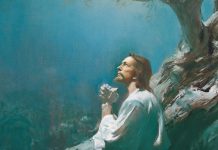
On the sixth of January, the Church commemorates the Baptism of our Lord Jesus Christ at the hands of John the Baptist in the River Jordan. As recorded in the Holy Gospel according to St. Luke (03:15-22): ” And as the people were in expectation, and all men reasoned in their hearts concerning John, whether perhaps he was the Christ, John answered them all, “I indeed baptize you with water, but he comes who is mightier than I, the strap of whose sandals I am not worthy to loosen. He will baptize you in the Holy Spirit and fire. His winnowing fan is in his hand, and he will thoroughly cleanse his threshing floor, and will gather the wheat into his barn; but he will burn up the chaff with unquenchable fire.”Then with many other exhortations he preached good news to the people, but Herod the tetrarch,† being reproved by him for Herodias, his brother’s‡ wife, and for all the evil things which Herod had done, added this also to them all, that he shut up John in prison. Now when all the people were baptized, Jesus also had been baptized and was praying. The sky was opened, and the Holy Spirit descended in a bodily form like a dove on him; and a voice came out of the sky, saying “You are my beloved Son. In you I am well pleased.”
The Mystery of Baptism: Death to the Old Man and Resurrection in Christ
In ecclesiastical and theological understanding, the Sacrament of Baptism is considered the “Gateway to the Mysteries” and the bridge from darkness to light. It is not merely a ritual of purification by water, but an act of total liberation from the dominion of the Old Man—the man of original sin inherited by humanity. By immersion in the waters of Baptism, the “Old Adam,” with all his worldly desires and separation from God, is buried, so that a “New Man” may be born from the womb of water and the Spirit—reconciled with the Creator and clothed in the robe of righteousness and holiness. The Baptism of our Lord in the Jordan was not due to a need for repentance, for He is the All-Holy and sinless One; rather, it was the inauguration of this salvific path. His descent into the water was a washing of our human nature, and His ascent was a proclamation of our victory over spiritual death, that all who are baptized in His Name may become partakers of His Divine Sonship and heirs of eternal life.
The Site of Christ’s Baptism
Since the third century, continuous Christian tradition places the site of Christ’s Baptism near the “Lower Ford,” five miles from the Dead Sea. Upon this site, the Greek Orthodox Monastery of St. John the Baptist was built. The Syriacs call this feast “Denho,” which means “The Dawning” or “The Manifestation.” Its Greek equivalent is “Epiphany,” the name by which the feast is known across European languages. The Arabic term “Ghattas” (Immersion) refers to Christ being immersed in the Jordan River for His Baptism.
John the Baptist Baptizes and Prepares the Way
The Gospel according to St. Mark (1:1-11) “The beginning of the Good News of Jesus Christ, the Son of God.
As it is written in the prophets, “Behold,† I send my messenger before your face, who will prepare your way before you:* the voice of one crying in the wilderness, ‘Make ready the way of the Lord! Make his paths straight!’ ” John came baptizing‡ in the wilderness and preaching the baptism of repentance for forgiveness of sins. All the country of Judea and all those of Jerusalem went out to him. They were baptized by him in the Jordan river, confessing their sins. John was clothed with camel’s hair and a leather belt around his waist. He ate locusts and wild honey. He preached, saying, “After me comes he who is mightier than I, the strap of whose sandals I am not worthy to stoop down and loosen. I baptized you in§ water, but he will baptize you in the Holy Spirit.” In those days, Jesus came from Nazareth of Galilee, and was baptized by John in the Jordan. Immediately coming up from the water, he saw the heavens parting and the Spirit descending on him like a dove. A voice came out of the sky, “You are my beloved Son, in whom I am well pleased.”
The Site of “Al-Maghtas”
Recently, significant information has been uncovered regarding the area of “Bethany Beyond the Jordan.” Archaeological excavations along Wadi Al-Kharrar since 1996, supported by biblical texts and Byzantine historians, confirm that the site where John preached and baptized—including the Baptism of Christ—is located on the East Bank of the Jordan River. During the 1997 excavations, a series of ancient sites were found along the valley, including a Byzantine monastery at Tell Al-Kharrar. The site features natural springs forming pools that flow into the Jordan, creating a pastoral oasis.
Elijah’s Hill (Tell Mar Elias)
Wadi Al-Kharrar is the modern name for “Saphsaphas,” which appears on the Madaba Mosaic Map. Near the monastery complex lies a hill known as Tell Mar Elias, the site from which the Prophet Elijah was taken up to heaven in a chariot of fire. Pilgrims have flocked here for centuries; the Russian Abbot Daniel wrote in 1106 AD about the cave where John the Baptist lived and the “beautiful stream of water” that still flows there.
The Baptismal Pools and the Church of St. John
Three pools dating from the Roman and Byzantine periods (3rd to 6th centuries AD) were discovered at Tell Al-Kharrar, designed for pilgrims to descend and be baptized. Archaeologists also uncovered the remains of a Byzantine church built during the reign of Emperor Anastasius, located 300 meters east of the river, marking the traditional spot of the Epiphany.
St. Mary of Egypt
The region is also tied to the legend of St. Mary of Egypt, who left a life of sin in Alexandria to find repentance in Jerusalem. After hearing a voice telling her, “Cross the Jordan and you shall find rest,” she spent 47 years in the Jordanian desert in prayer and fasting. She was discovered by the monk Zosimas, who gave her Holy Communion before her passing.
Epiphany Traditions in Lebanon
Epiphany (known as Al-Ghattas) holds a prestigious place in Lebanese customs, traditions, and folkloric practices, as documented extensively in Fuad Afram al-Bustani’s book, The Meaning of Days (Volume I).
The Passing of Christ: “Dayem Dayem”
One of the oldest Lebanese beliefs regarding Epiphany is that Christ passes by at midnight. He blesses the families waiting for Him—those who stay awake until midnight in joy and celebration. As He passes, He says: “Dayem! Dayem!” (meaning: “May your joy and delight be everlasting!”).
Families who sleep, lock their doors, or extinguish their lamps do not receive this blessing. Because of this, some Lebanese refer to the Eve of Epiphany as the “Night of Destiny” (Laylat al-Qadr), spending it in continuous supplication and prayer.
Folklore and Nature
In their evening tales, people say that all trees bow to Christ as He passes that night, except for the mulberry tree. For this reason, it is associated with pride and arrogance; people “punish” it by breaking its wood and burning it specifically on that night.
The Blessing of the “Mouneh” (Pantry)
Christ’s blessing also extends to the family’s provisions and stores, ensuring their supplies remain abundant—”Dayem Dayem.”
As midnight approaches, mothers rush to the “Beit al-Mouneh” (the pantry). They go to the wheat containers, various grains, jars of oil and olives, vats of wine or Arak, jars of ghee, pots of Qawarma (preserved meat), and baskets of raisins. They stir these contents while repeating “Dayem Dayem,” so that blessing overflows and the provisions last throughout the year.
Theological and Historical Aspects of the Baptism
Why was the Sinless Christ Baptized? The Church affirms He was baptized “to fulfill all righteousness.” By His baptism, He sanctified the waters of the Jordan, making them capable of granting “New Birth” to humanity. He was not cleansed by the water; rather, the water was cleansed by His touch.
The Manifestation of the Holy Trinity: It is called Theophany because the three Persons were manifested together: the Son in the water, the Holy Spirit as a dove, and the Father’s Voice from the heavens.
The Symbolism of the Jordan: Just as Joshua led Israel across the Jordan to the Promised Land, Jesus (the New Joshua) crosses the water to lead humanity into the Kingdom of Heaven.
Note: The information in this article is compiled from various documented ecclesiastical, theological, research, and media references/The Above Editorial & Video are from the 2015 Archive